Last week Amy and I were looking for seashells when we spied a strange shape out in the ocean. What looked like three tall masts or pilings loomed above the horizon. It was clearly not a sailing ship, but it took a few minutes to venture a guess that it was a section of the new Oregon Inlet bridge, now under construction, being towed to the work site.
Amy had her binoculars with her, so we took the following photo through the eye piece. The last photo is a cropped close-up.
We are not sure this is a structural element of the new bridge, but we think so. At any rate, we'd never before seen anything quite that that out in the ocean.
This month's Ocracoke Newsletter is Allie (Teenie) Scott's 1968 story of
Simon Garrish, Jr. and the US Life-Saving horse, Sambo. You can read it
by clicking here: www.villagecraftsmen.com/news042116.htm.
Wednesday, April 27, 2016
Tuesday, April 26, 2016
Do Not Feed the Ducks!
They are cute...especially the little ones. But they can be a nuisance for home owners and business owners. We are talking about ducks.
In recent years hundreds of mallards have taken up permanent residence in Ocracoke village. Although mallards are protected as migratory waterfowl, these critters are in no hurry to go anywhere, at least not as long as people feed them.
Please Do Not Feed the Ducks!
Feeding them is not good for the ducks...it is not good for residents & visitors...and it is not good for Ocracoke. Feeding the ducks, thereby interrupting their natural migratory instincts, leaves the ducks vulnerable to parasites, disease and death by automobiles. They are much healthier, and live longer, in the wild.
Here is some excellent information from Duck Arm-Y:
"Feeding native ducks is not necessary. They have wings and can fly to find food. Bread and other processed food kills ducks. They die of disease and malnutrition. Lettuce is NOT an appropriate food for ducks. ...A fed duck is a DEAD duck.
"Wild ducks need to eat the green foods that grow naturally in their environment in order to maintain good health and a normal lifespan. Their ability to fly and retain natural instincts for survival depends entirely on the foods they eat. By feeding wild (or dumped domestic ducks) you are contributing to their early death, shortening their lives ten-fold.
"Ducks can literally starve to death if they are fed bread. Bread has no nutritional value for a duck. It is like a human eating cardboard. It fills them up so they don’t look for real food. They die of malnutrition."
For more information, click here: http://outerbanksvoice.com/2016/04/17/ocracoke-group-says-no-to-euthanizing-ducks-crowding-town/.
This month's Ocracoke Newsletter is Allie (Teenie) Scott's 1968 story of Simon Garrish, Jr. and the US Life-Saving horse, Sambo. You can read it by clicking here: www.villagecraftsmen.com/news042116.htm.
In recent years hundreds of mallards have taken up permanent residence in Ocracoke village. Although mallards are protected as migratory waterfowl, these critters are in no hurry to go anywhere, at least not as long as people feed them.
Please Do Not Feed the Ducks!
Feeding them is not good for the ducks...it is not good for residents & visitors...and it is not good for Ocracoke. Feeding the ducks, thereby interrupting their natural migratory instincts, leaves the ducks vulnerable to parasites, disease and death by automobiles. They are much healthier, and live longer, in the wild.
Here is some excellent information from Duck Arm-Y:
"Feeding native ducks is not necessary. They have wings and can fly to find food. Bread and other processed food kills ducks. They die of disease and malnutrition. Lettuce is NOT an appropriate food for ducks. ...A fed duck is a DEAD duck.
"Wild ducks need to eat the green foods that grow naturally in their environment in order to maintain good health and a normal lifespan. Their ability to fly and retain natural instincts for survival depends entirely on the foods they eat. By feeding wild (or dumped domestic ducks) you are contributing to their early death, shortening their lives ten-fold.
"Ducks can literally starve to death if they are fed bread. Bread has no nutritional value for a duck. It is like a human eating cardboard. It fills them up so they don’t look for real food. They die of malnutrition."
For more information, click here: http://outerbanksvoice.com/2016/04/17/ocracoke-group-says-no-to-euthanizing-ducks-crowding-town/.
This month's Ocracoke Newsletter is Allie (Teenie) Scott's 1968 story of Simon Garrish, Jr. and the US Life-Saving horse, Sambo. You can read it by clicking here: www.villagecraftsmen.com/news042116.htm.
Monday, April 25, 2016
Rainbow
On Saturday, as we were enjoying conversation after our evening meal, Lachlan came running into the house announcing a rainbow forming in the east. David made this panoramic photo to share with our readers.
Click on the photo to view a larger image.
This month's Ocracoke Newsletter is Allie (Teenie) Scott's 1968 story of Simon Garrish, Jr. and the US Life-Saving horse, Sambo. You can read it by clicking here: www.villagecraftsmen.com/news042116.htm.
Click on the photo to view a larger image.
This month's Ocracoke Newsletter is Allie (Teenie) Scott's 1968 story of Simon Garrish, Jr. and the US Life-Saving horse, Sambo. You can read it by clicking here: www.villagecraftsmen.com/news042116.htm.
Friday, April 22, 2016
Violin made with a Pocket Knife
On April 13 I published the following news clipping about Ocracoke native Stanford Jackson (1859-1944).
For ease of reading, here is a transcript of the above article, almost certainly written by Aycock Brown:
"Ocracoke, July 7. --- Just after the August hurricane of 1899 Stamford [sic] Jackson, then a young man, set out the sprout of a cedar tree in his yard on Ocracoke Island. During the years the sprout grew and reached maturity. Came the September hurricane of 1933, and the cedar was uprooted like many other trees on the island. For many months the trunk of the tree, trimmed of its branches, lay in the open sun. A few weeks ago Stamford decided to make something from the cured wood by which to remember the sprout he set out during his youth.
"The photo shows Mr. Jackson and the result of his labors. With an ordinary pocket knife he fashioned the violin shown in the picture, supplied it with the strings, bridge and other equipment and now he has a violin which expert musicians declare to be a most unusual instrument."
At the time I wrote the April 13 blog post I had just located the photo the prior evening. Chester Lynn found it in a scrapbook, but I hadn't yet made a copy. Below is the photo of Stanford Jackson and his violin.
This month's Ocracoke Newsletter is Allie (Teenie) Scott's 1968 story of Simon Garrish, Jr. and the US Life-Saving horse, Sambo. You can read it by clicking here: www.villagecraftsmen.com/news042116.htm.
For ease of reading, here is a transcript of the above article, almost certainly written by Aycock Brown:
"Ocracoke, July 7. --- Just after the August hurricane of 1899 Stamford [sic] Jackson, then a young man, set out the sprout of a cedar tree in his yard on Ocracoke Island. During the years the sprout grew and reached maturity. Came the September hurricane of 1933, and the cedar was uprooted like many other trees on the island. For many months the trunk of the tree, trimmed of its branches, lay in the open sun. A few weeks ago Stamford decided to make something from the cured wood by which to remember the sprout he set out during his youth.
"The photo shows Mr. Jackson and the result of his labors. With an ordinary pocket knife he fashioned the violin shown in the picture, supplied it with the strings, bridge and other equipment and now he has a violin which expert musicians declare to be a most unusual instrument."
At the time I wrote the April 13 blog post I had just located the photo the prior evening. Chester Lynn found it in a scrapbook, but I hadn't yet made a copy. Below is the photo of Stanford Jackson and his violin.
This month's Ocracoke Newsletter is Allie (Teenie) Scott's 1968 story of Simon Garrish, Jr. and the US Life-Saving horse, Sambo. You can read it by clicking here: www.villagecraftsmen.com/news042116.htm.
Thursday, April 21, 2016
Sambo the Live-Saving Horse
This month's Ocracoke Newsletter is a story written in 1968 by Allie (Teenie) Scott. Island resident, Jen Esham, Allie's daughter, shared the story with me. It is a story about Simon Garrish, Jr. (1865-1935) and his United States Life-Saving horse, Sambo.
You can read the story here: www.villagecraftsmen.com/news042116.htm.
Wednesday, April 20, 2016
Starfish & Olive
A few days ago I was walking along the beach with Amy when I noticed this purple starfish (Astropecten articulatus, also called the Royal Starfish) that had washed up alongside a beautiful lettered olive (Oliva sayana) shell.
Sometimes starfish wash up on our beach in the hundreds. This time there was only one. When I picked it up I noticed that the tiny tube feet were still undulating. I tossed it back into the surf. Maybe it survived.
This month's Ocracoke Newsletter is about the 1977 recording of traditional Outer Banks folk music. You can read the article here: http://www.villagecraftsmen.com/news032116.htm.
Sometimes starfish wash up on our beach in the hundreds. This time there was only one. When I picked it up I noticed that the tiny tube feet were still undulating. I tossed it back into the surf. Maybe it survived.
This month's Ocracoke Newsletter is about the 1977 recording of traditional Outer Banks folk music. You can read the article here: http://www.villagecraftsmen.com/news032116.htm.
Tuesday, April 19, 2016
Portsmouth and the Civil War
As mentioned earlier this month, the biennial Portsmouth Island Homecoming is scheduled for Saturday, April 30. Following is an excerpt from an article in the September 27, 1953, News and Observer (Raleigh, NC).
"In due time the Civil War descended upon Portsmouth.... Fort Granville, built at Portsmouth in 1753, was fired by the Confederates. The Yankees swarmed over Portsmouth, took possession of the hospital, provisions, cattle and everything else. Old timers today tell that all Portsmouth residents left the island, all except one extremely portly lady, who was too large to be removed from her house -- she just couldn't get through the door. Later, after the Yankee storm had passed and the island residents returned home, the over-sized lady reported the Northern soldiers had treated her kindly."
This month's Ocracoke Newsletter is about the 1977 recording of traditional Outer Banks folk music. You can read the article here: http://www.villagecraftsmen.com/news032116.htm.
"In due time the Civil War descended upon Portsmouth.... Fort Granville, built at Portsmouth in 1753, was fired by the Confederates. The Yankees swarmed over Portsmouth, took possession of the hospital, provisions, cattle and everything else. Old timers today tell that all Portsmouth residents left the island, all except one extremely portly lady, who was too large to be removed from her house -- she just couldn't get through the door. Later, after the Yankee storm had passed and the island residents returned home, the over-sized lady reported the Northern soldiers had treated her kindly."
This month's Ocracoke Newsletter is about the 1977 recording of traditional Outer Banks folk music. You can read the article here: http://www.villagecraftsmen.com/news032116.htm.
Monday, April 18, 2016
Contest Winner
Congratulations to Greg Smith who submitted the winning entry to last week's contest. Greg guessed that the 1951 price of a 1/2 acre lot on Portsmouth Island was $22.50. His guess was the closest to the actual price of $15.99!
Below is a copy of the original deed. Click on the deed for a larger, easier to read image. For information about how to get an even better quality image please follow the directions on the right, under the icon for OcracokeNavigator.com.
Many thanks to all who entered our contest. We will be mailing this hand-crafted pottery bowl by Sunset Hill Stoneware to Greg in the next few days.
This month's Ocracoke Newsletter is about the 1977 recording of traditional Outer Banks folk music. You can read the article here: http://www.villagecraftsmen.com/news032116.htm.
Below is a copy of the original deed. Click on the deed for a larger, easier to read image. For information about how to get an even better quality image please follow the directions on the right, under the icon for OcracokeNavigator.com.
![]() |
| 1951 Deed |
Many thanks to all who entered our contest. We will be mailing this hand-crafted pottery bowl by Sunset Hill Stoneware to Greg in the next few days.
This month's Ocracoke Newsletter is about the 1977 recording of traditional Outer Banks folk music. You can read the article here: http://www.villagecraftsmen.com/news032116.htm.
Friday, April 15, 2016
The Albatross
Lately I have been reading Samuel Taylor Coleridge's epic poem, "The Rime of the Ancient Mariner." I was reminded of this photograph of Mrs. Abner Dixon who began teaching at the school on Portsmouth Island in 1917.
This is what Aycock Brown wrote in the Ocracoke Island Beacon on December 15, 1941:
"Elsewhere in this edition today is a picture of Mrs. Abner Dixon, teacher of North Carolina's smallest school, half of her student body, and a stuffed Albatross.... [T]he moth-eaten stuffed bird...at first appeared to be a gigantic sea gull. Interested we asked Mrs. Dixon about the bird, learned it was an albatross, and then wanted to know the story of how this gigantic seabird, native of Antarctic, happened to be at Portsmouth, so she told us this story.
"'Years ago a group of sportsmen arriving at Tom Bragg's for the duck and geese shooting, received as a joke from some friends who could not come along, the stuffed Albatross. They knew that...a live Albatross is an omen of good luck and that a dead one was an omen of bad luck. Whether the stuffed bird brought bad hunting luck to the party is not remembered.
"'After the party left, the big bird was passed from one family to another, each getting rid of it because of the superstition that it was bad luck to have it in the house. Finally, I told them that I was not superstitious, and to let me have the Albatross for the school. I cannot see that it has brought the school bad luck.'
"Then we asked Mrs. Dixon how many students she had enrolled when she first came to Portsmouth. 'About 35' was her reply. 'And how many did you have 10 years ago,' we asked. 'Fifteen or 20,' she added. 'And today you have only four pupils?' we asked. Her reply was in the affirmative."
This month's Ocracoke Newsletter is about the 1977 recording of traditional Outer Banks folk music. You can read the article here: http://www.villagecraftsmen.com/news032116.htm.
This is what Aycock Brown wrote in the Ocracoke Island Beacon on December 15, 1941:
"Elsewhere in this edition today is a picture of Mrs. Abner Dixon, teacher of North Carolina's smallest school, half of her student body, and a stuffed Albatross.... [T]he moth-eaten stuffed bird...at first appeared to be a gigantic sea gull. Interested we asked Mrs. Dixon about the bird, learned it was an albatross, and then wanted to know the story of how this gigantic seabird, native of Antarctic, happened to be at Portsmouth, so she told us this story.
"'Years ago a group of sportsmen arriving at Tom Bragg's for the duck and geese shooting, received as a joke from some friends who could not come along, the stuffed Albatross. They knew that...a live Albatross is an omen of good luck and that a dead one was an omen of bad luck. Whether the stuffed bird brought bad hunting luck to the party is not remembered.
"'After the party left, the big bird was passed from one family to another, each getting rid of it because of the superstition that it was bad luck to have it in the house. Finally, I told them that I was not superstitious, and to let me have the Albatross for the school. I cannot see that it has brought the school bad luck.'
"Then we asked Mrs. Dixon how many students she had enrolled when she first came to Portsmouth. 'About 35' was her reply. 'And how many did you have 10 years ago,' we asked. 'Fifteen or 20,' she added. 'And today you have only four pupils?' we asked. Her reply was in the affirmative."
-------------------------------------------
"God save thee Ancient Mariner,
From the fiends that plague thee thus.
Why looks thou so? With my crossbow
I shot the Albatross"
-------------------------------------------
This month's Ocracoke Newsletter is about the 1977 recording of traditional Outer Banks folk music. You can read the article here: http://www.villagecraftsmen.com/news032116.htm.
Thursday, April 14, 2016
Telephone Log
Telephones came to Ocracoke in 1956. In 2014 I published an Ocracoke Newsletter about telephones: http://www.villagecraftsmen.com/news022114.htm.
In the article, I wrote, "When I was a youngster there was only one telephone on the island -- at the Coast Guard station. According to cousin Blanche the US Coast Guard had a ship-to-shore radio telephone as long as she can remember, probably from the time of the construction of the village station in 1905."
I recently came across a transcript of part of a US Coast Guard log about calls made from the station's telephone during four days in February, 1941. Calls included several to Bells Drug Store in Beaufort, NC, "in regards to medicine," one to the Fisheries Commission "in regards to [an officer's] patrol," one to Atlantic, NC, "in regards to fish," one to City Grocery in Beaufort, NC, "relative to groceries," and one to Betts Bakery in Beaufort, NC, "relative to buying bread [for Clarence Scarborough's island grocery store]."
One incoming call from the Commander of the Norfolk District directed the Ocracoke Station to be on the lookout for a "possible thief" flying an airplane. Another incoming call to Mrs. George F. O'Neal from W. M. Hodges said simply, "Meet me at Atlantic Monday if I am not there wait until I get there."
What a difference from today's instant communication!
This month's Ocracoke Newsletter is about the 1977 recording of traditional Outer Banks folk music. You can read the article here: http://www.villagecraftsmen.com/news032116.htm.
In the article, I wrote, "When I was a youngster there was only one telephone on the island -- at the Coast Guard station. According to cousin Blanche the US Coast Guard had a ship-to-shore radio telephone as long as she can remember, probably from the time of the construction of the village station in 1905."
![]() |
| The Old Ocracoke Village USCG Station from OcracokeNavigator.com |
I recently came across a transcript of part of a US Coast Guard log about calls made from the station's telephone during four days in February, 1941. Calls included several to Bells Drug Store in Beaufort, NC, "in regards to medicine," one to the Fisheries Commission "in regards to [an officer's] patrol," one to Atlantic, NC, "in regards to fish," one to City Grocery in Beaufort, NC, "relative to groceries," and one to Betts Bakery in Beaufort, NC, "relative to buying bread [for Clarence Scarborough's island grocery store]."
One incoming call from the Commander of the Norfolk District directed the Ocracoke Station to be on the lookout for a "possible thief" flying an airplane. Another incoming call to Mrs. George F. O'Neal from W. M. Hodges said simply, "Meet me at Atlantic Monday if I am not there wait until I get there."
What a difference from today's instant communication!
This month's Ocracoke Newsletter is about the 1977 recording of traditional Outer Banks folk music. You can read the article here: http://www.villagecraftsmen.com/news032116.htm.
Wednesday, April 13, 2016
Stanford Jackson
Chester Lynn recently shared the following undated news clipping about Ocracoke Native Stanford Jackson (1859-1944).
I don't remember Mr. Jackson (he died the year I was born), but I had heard about him, and in 2008 I wrote this (http://www.villagecraftsmen.com/news092608.htm):
"In 1940 Mr. Stanford Jackson, an octogenarian island carpenter and recent convert, offered to build the new [Assembly of God] church if the materials could be procured and several helpers found. Eliza O'Neal's sons, John Thomas, and his bother, Steve, and several others volunteered their time.Construction was begun in 1941 and continued into 1942. Sanford Jackson built the first pews as well.
"An article in the Ocracoke Beacon, dated October 15, 1941, recalls, 'Stanford Jackson, expert craftsman, who can make anything from a fiddle to a ship model, with his pocket knife, is now completing a much bigger job. For several months, Stanford has been engaged (almost single-handed) in building the little church down on the Point Road which will be the place of worship for islanders of the Holiness Pentecostal faith.; The church is almost completed, and Stanford Jackson deserves praise for the fine job of carpentering he has done in building this place of worship.'"
[I just located the photo showing Stanford Jackson and his violin. I will publish it soon.]
This month's Ocracoke Newsletter is about the 1977 recording of traditional Outer Banks folk music. You can read the article here: http://www.villagecraftsmen.com/news032116.htm.
![]() |
| Click on image to view a larger version |
I don't remember Mr. Jackson (he died the year I was born), but I had heard about him, and in 2008 I wrote this (http://www.villagecraftsmen.com/news092608.htm):
"In 1940 Mr. Stanford Jackson, an octogenarian island carpenter and recent convert, offered to build the new [Assembly of God] church if the materials could be procured and several helpers found. Eliza O'Neal's sons, John Thomas, and his bother, Steve, and several others volunteered their time.Construction was begun in 1941 and continued into 1942. Sanford Jackson built the first pews as well.
"An article in the Ocracoke Beacon, dated October 15, 1941, recalls, 'Stanford Jackson, expert craftsman, who can make anything from a fiddle to a ship model, with his pocket knife, is now completing a much bigger job. For several months, Stanford has been engaged (almost single-handed) in building the little church down on the Point Road which will be the place of worship for islanders of the Holiness Pentecostal faith.; The church is almost completed, and Stanford Jackson deserves praise for the fine job of carpentering he has done in building this place of worship.'"
[I just located the photo showing Stanford Jackson and his violin. I will publish it soon.]
This month's Ocracoke Newsletter is about the 1977 recording of traditional Outer Banks folk music. You can read the article here: http://www.villagecraftsmen.com/news032116.htm.
Tuesday, April 12, 2016
Irvin Scott Garrish
Irvin Garrish and his wife Elsie Ballance Garrish were both born and raised on Ocracoke. Irvin's mother was a direct descendant of Agnes Scott for whom Agnes Scott College in Decatur, Georgia, is named. For a time Irvin & Elsie lived and worked off the island, but later returned to their island home on Howard Street. Irvin was a ferry captain and the island’s first representative to the
Hyde County board of commissioners. NC Highway 12 (Irvin Garrish Highway) is named for him. Elsie was the island’s nurse. Their daughters, Agnes and Martha, as well as other members of their family, live on the island today
In 2011 Kathy and Bob Phillips purchased their island house and completed a restoration project. The house was featured in an article on the Ocracoke Current.
Irvin was born April 20, 1916, and died in 1997. On Saturday, April 16, Bob & Kathy Phillips will be remembering Irvin by celebrating the 100th anniversary of his birth. You are invited to come to their home on Howard Street to remember Irvin and his many contributions to our community.
This month's Ocracoke Newsletter is about the 1977 recording of traditional Outer Banks folk music. You can read the article here: http://www.villagecraftsmen.com/news032116.htm.
In 2011 Kathy and Bob Phillips purchased their island house and completed a restoration project. The house was featured in an article on the Ocracoke Current.
Irvin was born April 20, 1916, and died in 1997. On Saturday, April 16, Bob & Kathy Phillips will be remembering Irvin by celebrating the 100th anniversary of his birth. You are invited to come to their home on Howard Street to remember Irvin and his many contributions to our community.
This month's Ocracoke Newsletter is about the 1977 recording of traditional Outer Banks folk music. You can read the article here: http://www.villagecraftsmen.com/news032116.htm.
Monday, April 11, 2016
Contest
I recently came across a document that recorded an April 8, 1951, sheriff's sale of a 1/2 acre parcel of land in Portsmouth village, just across Ocracoke Inlet. I am wondering if any of our readers can guess how much the bidder paid for the land. If you think you know (or have an educated guess), send us an email at info@villagecraftsmen.com (put "Sheriff's Sale" in the subject line) and fill in the blank in this sentence in the body of the email: "The purchase price of the land was $ ________."
The entry that comes closest to the actual amount will win one 5" hand-crafted pottery bowl by Sunset Hill Stoneware (retail value, $24.00). The bowl includes a "medallion" depicting the Ocracoke Lighthouse, created by Philip Howard, owner of Village Craftsmen.
Entries dated after 12 noon, April 15, 2016, will not be accepted. Winner will be announced on this blog April 18, 2016. A copy of the 1951 deed will be posted.
Please, one entry per email address (in case of multiple entries from the same email address, only the earliest dated email will be considered). The bowl will be shipped to any address in the United States of America chosen by the winner.
In case of a tie, one winner will be chosen at random from the winning entries.
Of course, employees of Village Craftsmen, and their immediate families, are not eligible to win.
This month's Ocracoke Newsletter is about the 1977 recording of traditional Outer Banks folk music. You can read the article here: http://www.villagecraftsmen.com/news032116.htm.
The entry that comes closest to the actual amount will win one 5" hand-crafted pottery bowl by Sunset Hill Stoneware (retail value, $24.00). The bowl includes a "medallion" depicting the Ocracoke Lighthouse, created by Philip Howard, owner of Village Craftsmen.
Entries dated after 12 noon, April 15, 2016, will not be accepted. Winner will be announced on this blog April 18, 2016. A copy of the 1951 deed will be posted.
Please, one entry per email address (in case of multiple entries from the same email address, only the earliest dated email will be considered). The bowl will be shipped to any address in the United States of America chosen by the winner.
In case of a tie, one winner will be chosen at random from the winning entries.
Of course, employees of Village Craftsmen, and their immediate families, are not eligible to win.
This month's Ocracoke Newsletter is about the 1977 recording of traditional Outer Banks folk music. You can read the article here: http://www.villagecraftsmen.com/news032116.htm.
Friday, April 08, 2016
Family Fun Run
Ocracoke Island's Fifth Annual 10K/5K and One Mile Family Fun Run will be held Saturday, April 23, starting at 8 a.m.
A new event this year is Ocracoke's First Annual Half Marathon. This will be held Sunday, April 24, also starting at 8 a.m. These events are benefits for several Ocracoke Island organizations including the Ocracoke Community Park, Ocracoke School Boosters Club, Ocracoke Community Radio, and Ocracoke Child Care. So far, almost $100,000 has been raised since 2012.
For more information and to register for the races please visit the official web site: http://www.ocracokeisland5krun.org/index.asp.
This month's Ocracoke Newsletter is about the 1977 recording of traditional Outer Banks folk music. You can read the article here: http://www.villagecraftsmen.com/news032116.htm.
A new event this year is Ocracoke's First Annual Half Marathon. This will be held Sunday, April 24, also starting at 8 a.m. These events are benefits for several Ocracoke Island organizations including the Ocracoke Community Park, Ocracoke School Boosters Club, Ocracoke Community Radio, and Ocracoke Child Care. So far, almost $100,000 has been raised since 2012.
For more information and to register for the races please visit the official web site: http://www.ocracokeisland5krun.org/index.asp.
This month's Ocracoke Newsletter is about the 1977 recording of traditional Outer Banks folk music. You can read the article here: http://www.villagecraftsmen.com/news032116.htm.
Thursday, April 07, 2016
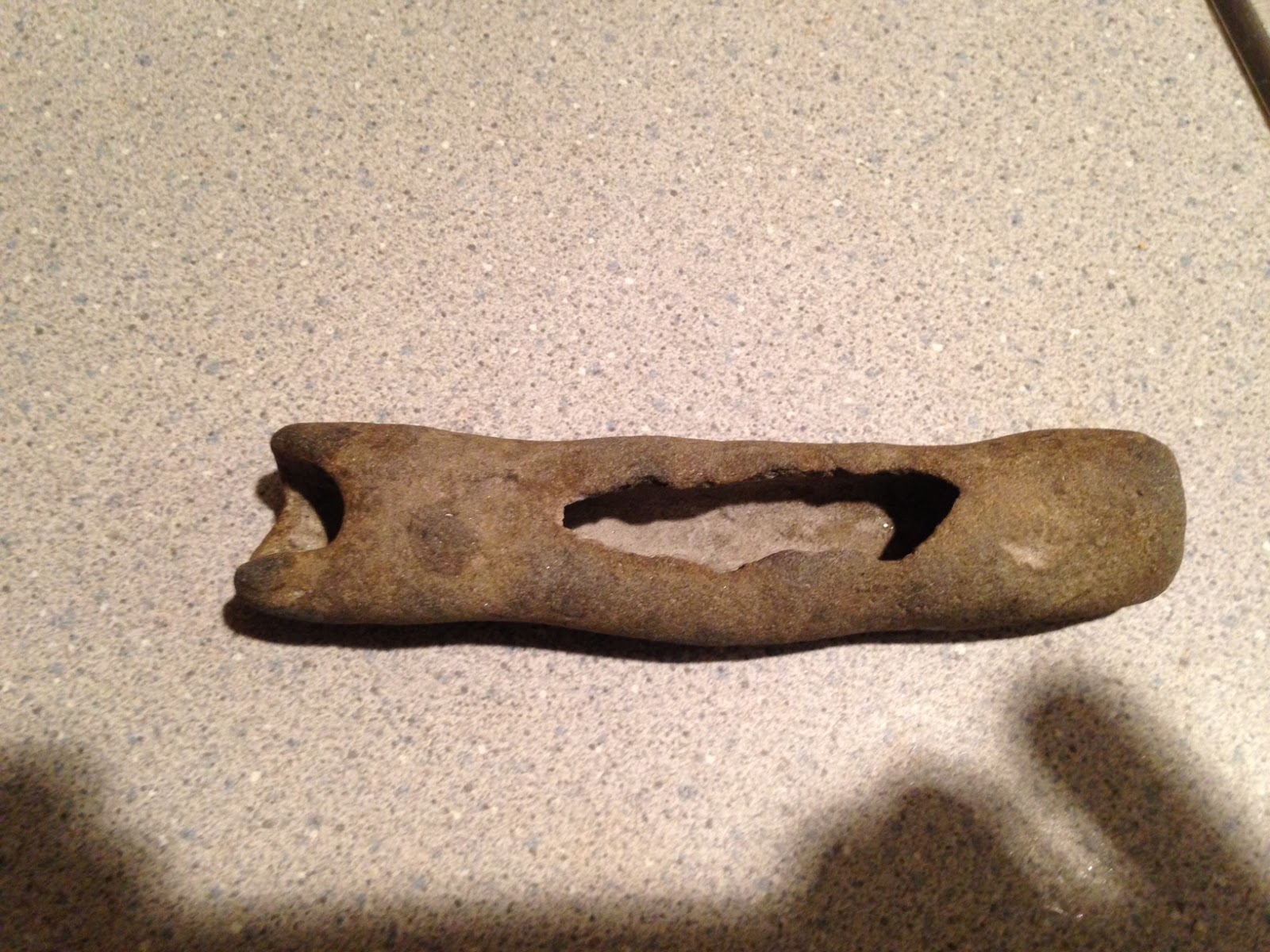
Whalebone?
After reading Tuesday's post about Native American pipes & pipe bowls and fossilized bison teeth (all found in the waters near Ocracoke) a reader sent me this photo of items he found in the same areas.
We think these items are whalebone. The bottom artifact appears to be some sort of tool made from whalebone.
In August of last year we published an article about Whale and Porpoise Fishing on the Outer Banks. It is a fascinating story that is not well known.
This month's Ocracoke Newsletter is about the 1977 recording of traditional Outer Banks folk music. You can read the article here: http://www.villagecraftsmen.com/news032116.htm.
We think these items are whalebone. The bottom artifact appears to be some sort of tool made from whalebone.
In August of last year we published an article about Whale and Porpoise Fishing on the Outer Banks. It is a fascinating story that is not well known.
![]() |
| 19th Century Depiction of Cutting Blubber |
This month's Ocracoke Newsletter is about the 1977 recording of traditional Outer Banks folk music. You can read the article here: http://www.villagecraftsmen.com/news032116.htm.
Wednesday, April 06, 2016
Portsmouth Island Homecoming
It is not too late to make plans for the upcoming biennial Portsmouth Island Homecoming.
This year's Homecoming is scheduled for Saturday, April 30. Not only is this the 50th Anniversary of Cape Lookout National Seashore and the 100th Anniversary of the National Park Service, but the Friends of Portsmouth Island, those wonderful people who plan this event, will be celebrating “The Families of Portsmouth." A special Descendant Tent will be set up for Portsmouth families to gather and share their photographs, family trees, scrapbooks, and memories.
Schedule of Events:
9:00 – Buildings/tents open, registration
9:30 – Christening service in church
10:00- Hymn singing in church / children’s activities begin
10:30- Group picture at the church
11:00- Homecoming program under the big tent
12:00- Dinner on the grounds
1:00 – Buildings reopen and children’s activities resume
2:00 – Boats begin returning to Ocracoke
The Post Office will again be open to stamp your mail from Portsmouth.
Portsmouth Island Homecoming has been a tradition since 1992. Portsmouth Village was established in 1753 as a transfer and storage site for goods passing through Ocracoke Inlet. At one time Portsmouth was larger than Ocracoke. However, by the 1950s the population had declined to fewer than 20. The last two remaining residents left the island in 1971.
Reservations for the trip from Ocracoke to Portsmouth should be made by calling Rudy Austin: 252-928-4361. The cost of the ride to Portsmouth is $20 per person round trip.
For more information please visit the Friends of Portsmouth Island web site.
You can read a first-time visitor's story of Portsmouth Island here: http://www.villagecraftsmen.com/news042115.htm.
This month's Ocracoke Newsletter is about the 1977 recording of traditional Outer Banks folk music. You can read the article here: http://www.villagecraftsmen.com/news032116.htm.
This year's Homecoming is scheduled for Saturday, April 30. Not only is this the 50th Anniversary of Cape Lookout National Seashore and the 100th Anniversary of the National Park Service, but the Friends of Portsmouth Island, those wonderful people who plan this event, will be celebrating “The Families of Portsmouth." A special Descendant Tent will be set up for Portsmouth families to gather and share their photographs, family trees, scrapbooks, and memories.
Schedule of Events:
9:00 – Buildings/tents open, registration
9:30 – Christening service in church
10:00- Hymn singing in church / children’s activities begin
10:30- Group picture at the church
11:00- Homecoming program under the big tent
12:00- Dinner on the grounds
1:00 – Buildings reopen and children’s activities resume
2:00 – Boats begin returning to Ocracoke
The Post Office will again be open to stamp your mail from Portsmouth.
Portsmouth Island Homecoming has been a tradition since 1992. Portsmouth Village was established in 1753 as a transfer and storage site for goods passing through Ocracoke Inlet. At one time Portsmouth was larger than Ocracoke. However, by the 1950s the population had declined to fewer than 20. The last two remaining residents left the island in 1971.
Reservations for the trip from Ocracoke to Portsmouth should be made by calling Rudy Austin: 252-928-4361. The cost of the ride to Portsmouth is $20 per person round trip.
For more information please visit the Friends of Portsmouth Island web site.
You can read a first-time visitor's story of Portsmouth Island here: http://www.villagecraftsmen.com/news042115.htm.
This month's Ocracoke Newsletter is about the 1977 recording of traditional Outer Banks folk music. You can read the article here: http://www.villagecraftsmen.com/news032116.htm.
Tuesday, April 05, 2016
Native American Pipe
In 2011 I published a post about a Native American pipe bowl I found many years ago in the water near Springer's Point (http://villagecraftsmen.blogspot.com/2011/04/native-american-pipe-bowl.html). I posted this photo:
Recently a friend found this fossilized bison's tooth in the water near where I discovered the pipe bowl (see http://villagecraftsmen.blogspot.com/2015/02/tooth-redux.html):
Just a few days ago another neighbor showed me this Native American pipe he found years ago:
A lot of fascinating activities were going on on Ocracoke Island before the first Europeans arrived. If only we knew more!
This month's Ocracoke Newsletter is about the 1977 recording of traditional Outer Banks folk music. You can read the article here: http://www.villagecraftsmen.com/news032116.htm.
Recently a friend found this fossilized bison's tooth in the water near where I discovered the pipe bowl (see http://villagecraftsmen.blogspot.com/2015/02/tooth-redux.html):
Just a few days ago another neighbor showed me this Native American pipe he found years ago:
A lot of fascinating activities were going on on Ocracoke Island before the first Europeans arrived. If only we knew more!
This month's Ocracoke Newsletter is about the 1977 recording of traditional Outer Banks folk music. You can read the article here: http://www.villagecraftsmen.com/news032116.htm.
Monday, April 04, 2016
Essie O'Neal
If you have known Ocracoke for many years you know there are many O'Neals who live on the island. This is, in large measure, because of Harry [1901-1977] and Essie [1915-1999] O'Neal. They had eleven sons.
In 1997 Christine Rucker of the Winston-Salem Journal wrote an article about Ocracoke. She interviewed Essie O'Neal, and included her brief account of the 1944 hurricane (Essie was 8 months pregnant with their fifth child when she and Harry loaded their four children into a boat as their house was flooding): "We floated down the street to [Harry's] sister's house, and floated over their fence posts and into her kitchen, and we all waited the storm out together."
Later in the article Rucker reports that Essie, in addition to washing clothes for her big family, made three meals a day, including 52 biscuits with each meal.
The Ocracoke Preservation Society has a display in the main hallway documenting the Ocracoke O'Neal family. Be sure to take a look when you are down that way. It is scheduled to be replaced sometime later this year.
This month's Ocracoke Newsletter is about the 1977 recording of traditional Outer Banks folk music. You can read the article here: http://www.villagecraftsmen.com/news032116.htm.
![]() |
| Essie O'Neal |
In 1997 Christine Rucker of the Winston-Salem Journal wrote an article about Ocracoke. She interviewed Essie O'Neal, and included her brief account of the 1944 hurricane (Essie was 8 months pregnant with their fifth child when she and Harry loaded their four children into a boat as their house was flooding): "We floated down the street to [Harry's] sister's house, and floated over their fence posts and into her kitchen, and we all waited the storm out together."
Later in the article Rucker reports that Essie, in addition to washing clothes for her big family, made three meals a day, including 52 biscuits with each meal.
The Ocracoke Preservation Society has a display in the main hallway documenting the Ocracoke O'Neal family. Be sure to take a look when you are down that way. It is scheduled to be replaced sometime later this year.
This month's Ocracoke Newsletter is about the 1977 recording of traditional Outer Banks folk music. You can read the article here: http://www.villagecraftsmen.com/news032116.htm.
Friday, April 01, 2016
Jellyfish
Imagine islanders' surprise early this morning when they came down to Silver Lake! The harbor was teeming with tens of thousands of jellyfish.
The jellyfish were so thick that fishing boats were disabled when water intake openings on outboard motors became clogged with the gelatinous critters. The "Invasion of the Jellyfish," as locals are calling this event, extends several miles into Pamlico Sound. Creative entrepreneurs have already begun thinking of ways to turn the jellyfish into tourist dollars.
According to Wikipedia, " Some species of jellyfish are edible for human consumption and are used as a source of food and as an ingredient in various dishes. Edible jellyfish is a seafood that is harvested and consumed in several Asian and Southeast Asian countries, and in some Asian countries it is considered to be a delicacy. Edible jellyfish is often processed into a dried product. Several types of foods and dishes may be prepared with edible jellyfish, including salads, sushi, noodles, main courses, and even ice cream."
Click here for more information on jellyfish and jellyfish invasions.
This month's Ocracoke Newsletter is about the 1977 recording of traditional Outer Banks folk music. You can read the article here: http://www.villagecraftsmen.com/news032116.htm.
The jellyfish were so thick that fishing boats were disabled when water intake openings on outboard motors became clogged with the gelatinous critters. The "Invasion of the Jellyfish," as locals are calling this event, extends several miles into Pamlico Sound. Creative entrepreneurs have already begun thinking of ways to turn the jellyfish into tourist dollars.
According to Wikipedia, " Some species of jellyfish are edible for human consumption and are used as a source of food and as an ingredient in various dishes. Edible jellyfish is a seafood that is harvested and consumed in several Asian and Southeast Asian countries, and in some Asian countries it is considered to be a delicacy. Edible jellyfish is often processed into a dried product. Several types of foods and dishes may be prepared with edible jellyfish, including salads, sushi, noodles, main courses, and even ice cream."
Click here for more information on jellyfish and jellyfish invasions.
This month's Ocracoke Newsletter is about the 1977 recording of traditional Outer Banks folk music. You can read the article here: http://www.villagecraftsmen.com/news032116.htm.
Thursday, March 31, 2016
Ribbon of Sand
Not too long ago reader Robb Foster posted a comment with a link to the on-line video, Ribbon of Sand -- North Carolina's Outer Banks. It is a beautiful video with stunning images of North Carolina's coastal islands, especially Portsmouth Island and Core Banks.
The video is almost 27 minutes long, so you might want to open the link above when you have enough time to watch the entire episode.
This month's Ocracoke Newsletter is about the 1977 recording of traditional Outer Banks folk music. You can read the article here: http://www.villagecraftsmen.com/news032116.htm.
The video is almost 27 minutes long, so you might want to open the link above when you have enough time to watch the entire episode.
This month's Ocracoke Newsletter is about the 1977 recording of traditional Outer Banks folk music. You can read the article here: http://www.villagecraftsmen.com/news032116.htm.
Wednesday, March 30, 2016
An Ocracoke Scene?
Yes, this really is an Ocracoke scene...from 1972. We had recently returned from working on Rocky Boy's Indian Reservation in north-central Montana, and decided to sell a few craft items on Ocracoke during the summer season. This tipi housed our nascent craft shop that morphed into Village Craftsmen just one year later.
As you can see, heavy rains caused some problems in those days. Our current wood-frame building is much more practical as a craft gallery!
Do any of our readers remember the tipi?
This month's Ocracoke Newsletter is about the 1977 recording of traditional Outer Banks folk music. You can read the article here: http://www.villagecraftsmen.com/news032116.htm.
As you can see, heavy rains caused some problems in those days. Our current wood-frame building is much more practical as a craft gallery!
Do any of our readers remember the tipi?
This month's Ocracoke Newsletter is about the 1977 recording of traditional Outer Banks folk music. You can read the article here: http://www.villagecraftsmen.com/news032116.htm.
Tuesday, March 29, 2016
Seine Fishing
The following photos are courtesy of Chester Lynn. They show several Ocracoke men mullet fishing in Pamlico Sound a half century ago.
The following article from the North Carolina Maritime Museum in Beaufort explains the process of "Stop Net Fishing" for mullet from the ocean beach in North Carolina: http://ncmaritimemuseums.com/wp-content/uploads/2015/04/Stop_Net_Fishing_for_Mullet.pdf.
This month's Ocracoke Newsletter is about the 1977 recording of traditional Outer Banks folk music. You can read the article here: http://www.villagecraftsmen.com/news032116.htm.
The following article from the North Carolina Maritime Museum in Beaufort explains the process of "Stop Net Fishing" for mullet from the ocean beach in North Carolina: http://ncmaritimemuseums.com/wp-content/uploads/2015/04/Stop_Net_Fishing_for_Mullet.pdf.
This month's Ocracoke Newsletter is about the 1977 recording of traditional Outer Banks folk music. You can read the article here: http://www.villagecraftsmen.com/news032116.htm.
Monday, March 28, 2016
Zora Babel
One of Ocracoke's more unusual names is Zora Babel (Babel is pronounced with a long a). This is a traditional man's name in the Gaskins family. The earliest reference I have been able to find is for William Zora Babel Gaskins (b. 1831) who was married to Mary Elizabeth Howard. The last Ocracoke native I can think of with this name was Zora Babel Gaskins (1932-2008).
I believe the name derives from Zerubbabel, a prominent character who is mentioned numerous times in the Bible. He was a governor of a Persian province, and led the first group of Jews who returned to Israel from the Babylonian Captivity between 538 and 520 BC. The name is from the Hebrew language, or possibly from the Babylonian language. Zəru Bābel in Babylonian means "Seed of Babylon."
Here is one biblical reference...Zechariah 4:9: “The hands of Zerub′babel have laid the foundation of this house; his hands shall also complete it."
This month's Ocracoke Newsletter is about the 1977 recording of traditional Outer Banks folk music. You can read the article here: http://www.villagecraftsmen.com/news032116.htm.
![]() |
| Zora Babel Gaskins (1855-1918) |
I believe the name derives from Zerubbabel, a prominent character who is mentioned numerous times in the Bible. He was a governor of a Persian province, and led the first group of Jews who returned to Israel from the Babylonian Captivity between 538 and 520 BC. The name is from the Hebrew language, or possibly from the Babylonian language. Zəru Bābel in Babylonian means "Seed of Babylon."
Here is one biblical reference...Zechariah 4:9: “The hands of Zerub′babel have laid the foundation of this house; his hands shall also complete it."
This month's Ocracoke Newsletter is about the 1977 recording of traditional Outer Banks folk music. You can read the article here: http://www.villagecraftsmen.com/news032116.htm.
Friday, March 25, 2016
Men & Draft Horses
In 1879, the Annual Report of the United States Life-saving Service called for the provision of draft horses at Life-saving stations on our coast. The appeal was repeated regularly. The following excerpt from the 1886 Report explains the urgent need. The USLSS was established in 1871. Horses were eventually employed beginning sometime in the late 19th century.
"Another urgent requirement...is the provision of horses. The lightest burden of apparatus or life-saving appliances needed at a wreck is at least a thousand pounds, and at present...this has to be drawn by men. It is probable that to fully realize the heavy task involved it would be necessary to actually see with the eye the group of seven surfmen harnessed to the loaded cart, violently tugging in oblique positions, almost inclined to the ground under the strain of the burden, as they toil forward to the scene of the shipwreck.
"It must be borne in mind that their load has often to be dragged through a slough of wet sand, against the stress of a winter gale, and that the journey will generally vary from one to three or four miles from the station [on Ocracoke Island the journey sometimes amounted to six or eight miles!]. Hence they must arrive seriously fatigued at the point where the severe labors of the direct operations at the wreck are to begin, and where they need their freshest energies. Equally bad, owing to the circumstances of their necessarily plodding progress with their grievous load, is the delay involved in reaching the wreck, a speedy arrival at which is so obvious a necessity that every one could wish that the rescuing party might come tearing along the beach at a gallop, with the speed of an engine racing to a fire."
This month's Ocracoke Newsletter is about the 1977 recording of traditional Outer Banks folk music. You can read the article here: http://www.villagecraftsmen.com/news032116.htm.
"Another urgent requirement...is the provision of horses. The lightest burden of apparatus or life-saving appliances needed at a wreck is at least a thousand pounds, and at present...this has to be drawn by men. It is probable that to fully realize the heavy task involved it would be necessary to actually see with the eye the group of seven surfmen harnessed to the loaded cart, violently tugging in oblique positions, almost inclined to the ground under the strain of the burden, as they toil forward to the scene of the shipwreck.
![]() |
| From Harper's Weekly, 1888 |
"It must be borne in mind that their load has often to be dragged through a slough of wet sand, against the stress of a winter gale, and that the journey will generally vary from one to three or four miles from the station [on Ocracoke Island the journey sometimes amounted to six or eight miles!]. Hence they must arrive seriously fatigued at the point where the severe labors of the direct operations at the wreck are to begin, and where they need their freshest energies. Equally bad, owing to the circumstances of their necessarily plodding progress with their grievous load, is the delay involved in reaching the wreck, a speedy arrival at which is so obvious a necessity that every one could wish that the rescuing party might come tearing along the beach at a gallop, with the speed of an engine racing to a fire."
This month's Ocracoke Newsletter is about the 1977 recording of traditional Outer Banks folk music. You can read the article here: http://www.villagecraftsmen.com/news032116.htm.
Thursday, March 24, 2016
Ocracoke Landing
Robert L. Payne, in his 1985 book, Place Names of the Outer Banks, lists many references to Ocracoke. One is "Ocracoke Landing -- a former landing [a place where a ship or boat was loaded or unloaded] in Hyde County, Ocracoke Township at 35° 09' 20" N 76° 00' 35" W and located but not named on Chart 11550. The landing was in Pamlico Sound, 2 mi. (3.2 km) north of the village of Ocracoke."
Payne adds this historical note: "The landing was actually the hulk of a sunken ship where boats anchored to transfer goods for the village of Ocracoke. The site was used for only a short period of time. Today Big Foot Slough Channel extends south from here."
You can locate this wreck at the top of the chart: http://www.charts.noaa.gov/OnLineViewer/11550.shtml. WK mean "Wreck" and PA means "Position Approximate." [A correction on 3/25/16: the wreck shown at the top of Chart 11550 is the Lehigh (http://villagecraftsmen.blogspot.com/2012/10/the-lehigh.html), not an older wreck as stated in Payne's book.]
This month's Ocracoke Newsletter is about the 1977 recording of traditional Outer Banks folk music. You can read the article here: http://www.villagecraftsmen.com/news032116.htm.
Payne adds this historical note: "The landing was actually the hulk of a sunken ship where boats anchored to transfer goods for the village of Ocracoke. The site was used for only a short period of time. Today Big Foot Slough Channel extends south from here."
You can locate this wreck at the top of the chart: http://www.charts.noaa.gov/OnLineViewer/11550.shtml. WK mean "Wreck" and PA means "Position Approximate." [A correction on 3/25/16: the wreck shown at the top of Chart 11550 is the Lehigh (http://villagecraftsmen.blogspot.com/2012/10/the-lehigh.html), not an older wreck as stated in Payne's book.]
This month's Ocracoke Newsletter is about the 1977 recording of traditional Outer Banks folk music. You can read the article here: http://www.villagecraftsmen.com/news032116.htm.
Wednesday, March 23, 2016
Navy Base
Below is an old photo of the Ocracoke Navy Base. It was located where the National Park Service Visitors Center is situated today. I have added three arrows and text boxes to help viewers understand the orientation. The NCCAT building (the former US Coast Guard Station) is in the upper left; the pre-WWII Coast Guard Station (no longer extant) is to the right of the NCCAT building; and the large cylindrical water cistern (the only other structure still remaining) is slightly above and to the left of the center of the photo. A small area of Pamlico Sound is visible at the top of the photo. Silver Lake harbor is off the picture, on the left.
Click on the photo to view a larger image, and to read the text.
This month's Ocracoke Newsletter is about the 1977 recording of traditional Outer Banks folk music. You can read the article here: http://www.villagecraftsmen.com/news032116.htm.
![]() |
| From the Chester Lynn Collection |
Click on the photo to view a larger image, and to read the text.
This month's Ocracoke Newsletter is about the 1977 recording of traditional Outer Banks folk music. You can read the article here: http://www.villagecraftsmen.com/news032116.htm.
Tuesday, March 22, 2016
Clam Chowder Cook-off
This coming Saturday, March 26, is the date for Ocracoke's second annual Clam Chowder Cook-off. This benefit for the Ocracoke Child Care will take place from 11:30
a.m. to 2:30 p.m. in the Ocracoke Community Center.
Last year eleven island cooks participated, and more than 160 people sampled the chowders, and voted.
Everyone is invited to participate -- individuals, businesses, organizations, restaurants, and amateur & professional cooks. There are two categories: traditional Ocracoke style (the only ingredients allowed are clams and their juice, water, potatoes, onions, salt pork or bacon, and salt & pepper), and non-traditional (this includes the addition of any other ingredients, although pepper vinegar and hot sauce may be used as condiments with traditional or non-traditional chowder).
Ocracoke artist, Susan Dodd, has created “Golden Clammy” trophies to be presented to the winners.
All proceeds from the event will benefit Ocracoke Child Care.
This month's Ocracoke Newsletter is about the 1977 recording of traditional Outer Banks folk music. You can read the article here: http://www.villagecraftsmen.com/news032116.htm.
Last year eleven island cooks participated, and more than 160 people sampled the chowders, and voted.
![]() |
| Contestants and Tasters in 2015 |
Everyone is invited to participate -- individuals, businesses, organizations, restaurants, and amateur & professional cooks. There are two categories: traditional Ocracoke style (the only ingredients allowed are clams and their juice, water, potatoes, onions, salt pork or bacon, and salt & pepper), and non-traditional (this includes the addition of any other ingredients, although pepper vinegar and hot sauce may be used as condiments with traditional or non-traditional chowder).
Ocracoke artist, Susan Dodd, has created “Golden Clammy” trophies to be presented to the winners.
| One of Last Year's Trophies |
All proceeds from the event will benefit Ocracoke Child Care.
This month's Ocracoke Newsletter is about the 1977 recording of traditional Outer Banks folk music. You can read the article here: http://www.villagecraftsmen.com/news032116.htm.
Monday, March 21, 2016
Between the Sound and the Sea
This month's Ocracoke Newsletter is an article about a recording of traditional folk music of the Outer Banks. Compiled by Karen Helms in 1977, the album, Between the Sound and the Sea, features five native Ocracokers.
They are Elizabeth Howard, Edgar Howard, Lawton Howard, Maurice Ballance, and Jule Garrish.
You can read the article here: http://www.villagecraftsmen.com/news032116.htm.
They are Elizabeth Howard, Edgar Howard, Lawton Howard, Maurice Ballance, and Jule Garrish.
You can read the article here: http://www.villagecraftsmen.com/news032116.htm.
Friday, March 18, 2016
Village Craftsmen
Village Craftsmen is open for the season beginning today at 10 am. When you are on the island be sure to take a leisurely stroll down historic Howard Street. Notice the centuries-old cottages, the majestic live oaks, the water cisterns from a different era, and the small family cemeteries (5 generations of Village Craftsmen's owner, Philip Howard, are buried directly across the sandy lane).
The friendly folks at Village Craftsmen will be waiting to welcome you to the island and to our quiet and secluded area of the village. Don't hesitate to sit for a spell on our porch, and enjoy the tranquility of island life.
While browsing inside our gallery, you will discover an eclectic assortment of local, regional, and other American made handcrafts, including pottery, stained glass, wood carvings, jewelry, metalcraft, and much more. Below are just a few samples of our quality handcrafts.
Our latest Ocracoke Newsletter is the story of Beatrice Wells, child evangelist, who preached at Ocracoke in the late 1930s/early 1940s. You can read it here: http://www.villagecraftsmen.com/news022116.htm.
The friendly folks at Village Craftsmen will be waiting to welcome you to the island and to our quiet and secluded area of the village. Don't hesitate to sit for a spell on our porch, and enjoy the tranquility of island life.
While browsing inside our gallery, you will discover an eclectic assortment of local, regional, and other American made handcrafts, including pottery, stained glass, wood carvings, jewelry, metalcraft, and much more. Below are just a few samples of our quality handcrafts.
![]() |
| Pottery by Margaret Hayes |
![]() |
| Ships-in-Bottles by Jim Goodwin |
![]() |
| Stained Glass Lamps by Allison |
![]() |
| Wooden Kitchen Utensils by Jonathan |
Our latest Ocracoke Newsletter is the story of Beatrice Wells, child evangelist, who preached at Ocracoke in the late 1930s/early 1940s. You can read it here: http://www.villagecraftsmen.com/news022116.htm.
Thursday, March 17, 2016
Ocracoke Library
In November, 2015, Ocracoke Preservation Society published an on-line exhibit featuring the history of the Ocracoke Library. The article includes this photo of Marguerite Boos in the 80-square-foot building which served as the island library (and the country's smallest library) for twenty years.
You can visit OPS's on-line exhibit by following this link: http://ocracokepreservation.org/november-online-exhibit/.
Our latest Ocracoke Newsletter is the story of Beatrice Wells, child evangelist, who preached at Ocracoke in the late 1930s/early 1940s. You can read it here: http://www.villagecraftsmen.com/news022116.htm.
You can visit OPS's on-line exhibit by following this link: http://ocracokepreservation.org/november-online-exhibit/.
Our latest Ocracoke Newsletter is the story of Beatrice Wells, child evangelist, who preached at Ocracoke in the late 1930s/early 1940s. You can read it here: http://www.villagecraftsmen.com/news022116.htm.
Wednesday, March 16, 2016
Old Quawk's Day
About 200 years ago there lived on Ocracoke Island a fisherman of
indeterminate provenance. He was a reclusive figure, preferring to live
in a small hut made of driftwood and bullrushes about 5-6 miles from the
village. No one remembers his given name, but folks called him "Old
Quawk" because, they said, he "quawked" like an old night heron.
Old Quawk was a fisherman, often venturing out into Pamlico Sound in his sail skiff when cautious islanders stayed in port waiting for more propitious weather.
On this date, March 16, many years past, Old Quawk made his last voyage into Pamlico Sound. Storm clouds were piling up in the darkening sky. Legend has it that Old Quawk defiantly disregarded the warnings of other islanders, raised his clenched fist to the heavens and dared the gods to thwart him, then set out in his sail skiff. A frightful gale churned the Sound into a wild turbulence and swamped Old Quawk's tiny craft. Neither Old Quawk nor his boat were ever found.
For many years Ocracoke fishermen refused to go out in their boats on March 16. Even today it's best to be prudent on Old Quawk's Day. There's no telling what the weather gods will dish out on March 16.
Our latest Ocracoke Newsletter is the story of Beatrice Wells, child evangelist, who preached at Ocracoke in the late 1930s/early 1940s. You can read it here: http://www.villagecraftsmen.com/news022116.htm.
Old Quawk was a fisherman, often venturing out into Pamlico Sound in his sail skiff when cautious islanders stayed in port waiting for more propitious weather.
On this date, March 16, many years past, Old Quawk made his last voyage into Pamlico Sound. Storm clouds were piling up in the darkening sky. Legend has it that Old Quawk defiantly disregarded the warnings of other islanders, raised his clenched fist to the heavens and dared the gods to thwart him, then set out in his sail skiff. A frightful gale churned the Sound into a wild turbulence and swamped Old Quawk's tiny craft. Neither Old Quawk nor his boat were ever found.
![]() |
| "Old Quawk" in July 4th Parade |
For many years Ocracoke fishermen refused to go out in their boats on March 16. Even today it's best to be prudent on Old Quawk's Day. There's no telling what the weather gods will dish out on March 16.
Our latest Ocracoke Newsletter is the story of Beatrice Wells, child evangelist, who preached at Ocracoke in the late 1930s/early 1940s. You can read it here: http://www.villagecraftsmen.com/news022116.htm.
Tuesday, March 15, 2016
White Tree Trunks
This late 19th century photo shows lighthouse keeper Enoch Ellis Howard and his wife Cordelia outside the house on the lighthouse property. Notice that the bottoms of the trees have all been painted white.
On Ocracoke and other places around the world it was once common practice to paint trees, although the practice is not as widespread nowadays. In the 1950s I remember seeing the bottom 4-6 feet of my Uncle Marvin's trees (on Howard Street) all painted white. I thought it was just for decoration, but have learned that it may protect trees (especially young trees) from insect infestation and from splitting and cracking.
I am wondering if any of our readers remember seeing painted trees when they were younger.
Our latest Ocracoke Newsletter is the story of Beatrice Wells, child evangelist, who preached at Ocracoke in the late 1930s/early 1940s. You can read it here: http://www.villagecraftsmen.com/news022116.htm.
On Ocracoke and other places around the world it was once common practice to paint trees, although the practice is not as widespread nowadays. In the 1950s I remember seeing the bottom 4-6 feet of my Uncle Marvin's trees (on Howard Street) all painted white. I thought it was just for decoration, but have learned that it may protect trees (especially young trees) from insect infestation and from splitting and cracking.
I am wondering if any of our readers remember seeing painted trees when they were younger.
Our latest Ocracoke Newsletter is the story of Beatrice Wells, child evangelist, who preached at Ocracoke in the late 1930s/early 1940s. You can read it here: http://www.villagecraftsmen.com/news022116.htm.
Monday, March 14, 2016
Moonshine
In June, 2015, I published an Ocracoke Newsletter article about "Rum Running on the Outer Banks." Apparently a few readers missed that article. Here is the link: http://www.villagecraftsmen.com/news062115.htm.
A reader [gsmith (outsideofapex)] who read the article recently posted this short Ocracoke story in a comment:
"My wife is from Appalachia. Her cousin told me a story about how his parents and another couple visited Ocracoke in the early 1950s. Seems once they got to the island and found a place to lodge in the upstairs of someone's home, the wives, while unpacking, to their dismay, found one of the trunks full of Appalachia's finest moonshine. Being God-fearing women they gave their menfolk an earful. However, after a day or two of observing how their husbands used that bounty to get the best meals, sunset boat rides, tours of the beach and so on, they grudgingly admitted that it was a brilliant idea!"
In the 1950s Ocracoke was a dry township, but locals frequently partook of homemade fermented "meal wine." Distilled beverages were much rarer. It was said that if someone laid a hundred dollar bill on the hood of their car, and weighted it down with a fifth of liquor, on the next morning they would find the hundred dollar bill still there, weighted down with a big conch shell.
Follow this link to listen to Ocracoke Island native, Jule Garrish, perform the "The Booze Yacht" ,
the song mentioned in the Newsletter article about rum running: https://www.youtube.com/watch?v=-xpeeJwR8k0.
Our latest Ocracoke Newsletter is the story of Beatrice Wells, child evangelist, who preached at Ocracoke in the late 1930s/early 1940s. You can read it here: http://www.villagecraftsmen.com/news022116.htm.
A reader [gsmith (outsideofapex)] who read the article recently posted this short Ocracoke story in a comment:
"My wife is from Appalachia. Her cousin told me a story about how his parents and another couple visited Ocracoke in the early 1950s. Seems once they got to the island and found a place to lodge in the upstairs of someone's home, the wives, while unpacking, to their dismay, found one of the trunks full of Appalachia's finest moonshine. Being God-fearing women they gave their menfolk an earful. However, after a day or two of observing how their husbands used that bounty to get the best meals, sunset boat rides, tours of the beach and so on, they grudgingly admitted that it was a brilliant idea!"
In the 1950s Ocracoke was a dry township, but locals frequently partook of homemade fermented "meal wine." Distilled beverages were much rarer. It was said that if someone laid a hundred dollar bill on the hood of their car, and weighted it down with a fifth of liquor, on the next morning they would find the hundred dollar bill still there, weighted down with a big conch shell.
Follow this link to listen to Ocracoke Island native, Jule Garrish, perform the "The Booze Yacht" ,
the song mentioned in the Newsletter article about rum running: https://www.youtube.com/watch?v=-xpeeJwR8k0.
Our latest Ocracoke Newsletter is the story of Beatrice Wells, child evangelist, who preached at Ocracoke in the late 1930s/early 1940s. You can read it here: http://www.villagecraftsmen.com/news022116.htm.
Friday, March 11, 2016
Daffodil
Warmer weather has arrived on Ocracoke, so spring must be close behind. According to tradition, I must post a photo of one of our daffodils. This one, which is in Amy & David's yard, started to bloom a few days ago.
Daffodil is one of the common names for the Narcissus plant.
According to Wikipedia, "The exact origin of the name Narcissus is unknown, but it is often linked to a Greek word for intoxicated (narcotic) and the myth of the youth of that name who fell in love with his own reflection. The English word 'daffodil' appears to be derived from "asphodel", with which it was commonly compared."
Our latest Ocracoke Newsletter is the story of Beatrice Wells, child evangelist, who preached at Ocracoke in the late 1930s/early 1940s. You can read it here: http://www.villagecraftsmen.com/news022116.htm.
Daffodil is one of the common names for the Narcissus plant.
According to Wikipedia, "The exact origin of the name Narcissus is unknown, but it is often linked to a Greek word for intoxicated (narcotic) and the myth of the youth of that name who fell in love with his own reflection. The English word 'daffodil' appears to be derived from "asphodel", with which it was commonly compared."
Our latest Ocracoke Newsletter is the story of Beatrice Wells, child evangelist, who preached at Ocracoke in the late 1930s/early 1940s. You can read it here: http://www.villagecraftsmen.com/news022116.htm.
Thursday, March 10, 2016
Electricity on Ocracoke
Ever wonder how and when Ocracoke first got electric power? Hint: it was before WWII, and there were no electric wires laid under Hatteras Inlet as there are today.
You can find out about this subject at the OPS Spring Membership Meeting Tuesday, March 15, 2016, at 7:00 pm at Deepwater Theater. Heidi Smith from Tideland EMC will be the guest speaker. She will share stories about the evolution of power on Ocracoke and how Tideland came to be our energy provider. Heide will also give us a peek at new energy programs Tideland EMC is working on.
In addition to partaking in tasty desserts with friends, you can help support the Ocracoke Preservation Society by renewing your membership or becoming a new member. We hope to see you there!
Our latest Ocracoke Newsletter is the story of Beatrice Wells, child evangelist, who preached at Ocracoke in the late 1930s/early 1940s. You can read it here: http://www.villagecraftsmen.com/news022116.htm.
![]() |
| Photo by C. Leinbach, Ocracoke Observer |
You can find out about this subject at the OPS Spring Membership Meeting Tuesday, March 15, 2016, at 7:00 pm at Deepwater Theater. Heidi Smith from Tideland EMC will be the guest speaker. She will share stories about the evolution of power on Ocracoke and how Tideland came to be our energy provider. Heide will also give us a peek at new energy programs Tideland EMC is working on.
In addition to partaking in tasty desserts with friends, you can help support the Ocracoke Preservation Society by renewing your membership or becoming a new member. We hope to see you there!
Our latest Ocracoke Newsletter is the story of Beatrice Wells, child evangelist, who preached at Ocracoke in the late 1930s/early 1940s. You can read it here: http://www.villagecraftsmen.com/news022116.htm.
Wednesday, March 09, 2016
Rescues by Ferry Crew
In the past two years, crew members of the North Carolina Ferry System have been involved in four rescues of mariners in coastal waters. On September 26, 2013, the crew of the Motor Vessel Cedar Island rescued two sailors in rough seas near Ocracoke. On March 29 and July 4 of 2015, North Carolina ferry crews came to the aid of several men whose sailboats had overturned in the Neuse River.
On August 29, 2015, the crew of the Motor Vessel Silver Lake rescued a father and son in Swan Quarter Bay. On Tuesday of last week (March 3, 2016) the crew was honored by the United States Coast Guard for their life-saving actions. Below is the press release from the NC Ferry Division.
Raleigh - The crew of the NCDOT Ferry M/V Silver Lake was honored today with a Meritorious Public Service Award from the United States Coast Guard for the crew’s actions in rescuing a father and son whose boat had overturned in Swan Quarter Bay. “The bravery and acts of heroism are a testament to the professionalism and caliber of the Motor Vessel Silver Lake crew," said Coast Guard Acting Sector Commander Benjamin Cooper. “The father and son are alive today as a direct result.” The incident occurred Saturday, Aug. 29, 2015, as the Silver Lake’s was on its 9:30 a.m. run between Ocracoke and Swan Quarter. As the ferry approached Swan Quarter, Captain Mark Piner noticed an overturned boat in the water with two people clinging to it. Piner immediately ordered the crew to launch the ferry’s rescue boat, and crew members Daniel Smith and Simon Robinette piloted it to the capsized vessel and pulled George and Justin Peele out of the water and into the rescue boat. After determining that both men were unharmed, the crew brought the father and son onboard the M/V Silver Lake and the ferry completed its run to Swan Quarter.
Upon reaching the ferry terminal, crew member Robinette returned both men to their vehicle at a nearby boat ramp. “We are incredibly proud of the Silver Lake crew for its life-saving actions last August,” said Ferry Division Director Ed Goodwin. “All of our crews are trained extensively in responding to emergencies on the water, and it’s good to know how much that training pays off.” Receiving the award today were Captain Piner and Crew Members Smith and Robinette, as well as Chief Engineers Gerry Gillikin and David P. Styron and Crew Member Randy K. Willis.
Our latest Ocracoke Newsletter is the story of Beatrice Wells, child evangelist, who preached at Ocracoke in the late 1930s/early 1940s. You can read it here: http://www.villagecraftsmen.com/news022116.htm.
On August 29, 2015, the crew of the Motor Vessel Silver Lake rescued a father and son in Swan Quarter Bay. On Tuesday of last week (March 3, 2016) the crew was honored by the United States Coast Guard for their life-saving actions. Below is the press release from the NC Ferry Division.
Raleigh - The crew of the NCDOT Ferry M/V Silver Lake was honored today with a Meritorious Public Service Award from the United States Coast Guard for the crew’s actions in rescuing a father and son whose boat had overturned in Swan Quarter Bay. “The bravery and acts of heroism are a testament to the professionalism and caliber of the Motor Vessel Silver Lake crew," said Coast Guard Acting Sector Commander Benjamin Cooper. “The father and son are alive today as a direct result.” The incident occurred Saturday, Aug. 29, 2015, as the Silver Lake’s was on its 9:30 a.m. run between Ocracoke and Swan Quarter. As the ferry approached Swan Quarter, Captain Mark Piner noticed an overturned boat in the water with two people clinging to it. Piner immediately ordered the crew to launch the ferry’s rescue boat, and crew members Daniel Smith and Simon Robinette piloted it to the capsized vessel and pulled George and Justin Peele out of the water and into the rescue boat. After determining that both men were unharmed, the crew brought the father and son onboard the M/V Silver Lake and the ferry completed its run to Swan Quarter.
Upon reaching the ferry terminal, crew member Robinette returned both men to their vehicle at a nearby boat ramp. “We are incredibly proud of the Silver Lake crew for its life-saving actions last August,” said Ferry Division Director Ed Goodwin. “All of our crews are trained extensively in responding to emergencies on the water, and it’s good to know how much that training pays off.” Receiving the award today were Captain Piner and Crew Members Smith and Robinette, as well as Chief Engineers Gerry Gillikin and David P. Styron and Crew Member Randy K. Willis.
Our latest Ocracoke Newsletter is the story of Beatrice Wells, child evangelist, who preached at Ocracoke in the late 1930s/early 1940s. You can read it here: http://www.villagecraftsmen.com/news022116.htm.
Tuesday, March 08, 2016
Frank Treat
Frank Treat Fulcher was one of Ocracoke's quirkier characters. Born on the island in 1878, he went to sea when he was ten years old. He served on many coastal schooners, was shipwrecked at least once, and then sailed around the world as a mariner on a square rigger. He later became a Methodist preacher. He returned regularly to Ocracoke where he was known for his folksy wisdom and colorful sermons.
Recently the Ocracoke Preservation Society, thanks to a grant from the Ocracoke Occupancy Tax Board, embarked on a program to add on-line exhibits to its web site. Their most recent entry is the story of Frank Treat's life.
You can read Frank Treat's short autobiography, and see more photos, in the OPS website or in Village Craftsmen's May 20, 2011 Ocracoke Newsletter.
Our latest Ocracoke Newsletter is the story of Beatrice Wells, child evangelist, who preached at Ocracoke in the late 1930s/early 1940s. You can read it here: http://www.villagecraftsmen.com/news022116.htm.
Recently the Ocracoke Preservation Society, thanks to a grant from the Ocracoke Occupancy Tax Board, embarked on a program to add on-line exhibits to its web site. Their most recent entry is the story of Frank Treat's life.
![]() |
| Frank Treat Fulcher |
You can read Frank Treat's short autobiography, and see more photos, in the OPS website or in Village Craftsmen's May 20, 2011 Ocracoke Newsletter.
Our latest Ocracoke Newsletter is the story of Beatrice Wells, child evangelist, who preached at Ocracoke in the late 1930s/early 1940s. You can read it here: http://www.villagecraftsmen.com/news022116.htm.
Monday, March 07, 2016
Pamlico Sound
Pamlico Sound is a beautiful body of water in all seasons of the year. It is perfect for fishing, clamming, swimming, sailing, or, if it is very cold, simply enjoying from a vantage point along the marsh.
Our latest Ocracoke Newsletter is the story of Beatrice Wells, child evangelist, who preached at Ocracoke in the late 1930s/early 1940s. You can read it here: http://www.villagecraftsmen.com/news022116.htm.
Friday, March 04, 2016
USLSS Beach Drill
Yesterday I published a photo of members of the United States Life Saving Service practicing a "breeches buoy" rescue operation on land. Below is another photo from the Outer Banks History Center. This one shows life savers practicing on the beach with their surf boat.
On the extreme left is the 1,000 pound "beach cart" loaded with all of the equipment that the life savers pulled along the surf. In the foreground is a portion of the "faking box" (with rows of wooden pins around which the shot line was woven in a zig-zag pattern to prevent tangling when emptied beside the Lyle Gun).
Rescues were rarely performed when the surf was as calm as in this photo, or the temperature as mild.
Our latest Ocracoke Newsletter is the story of Beatrice Wells, child evangelist, who preached at Ocracoke in the late 1930s/early 1940s. You can read it here: http://www.villagecraftsmen.com/news022116.htm.
On the extreme left is the 1,000 pound "beach cart" loaded with all of the equipment that the life savers pulled along the surf. In the foreground is a portion of the "faking box" (with rows of wooden pins around which the shot line was woven in a zig-zag pattern to prevent tangling when emptied beside the Lyle Gun).
Rescues were rarely performed when the surf was as calm as in this photo, or the temperature as mild.
Our latest Ocracoke Newsletter is the story of Beatrice Wells, child evangelist, who preached at Ocracoke in the late 1930s/early 1940s. You can read it here: http://www.villagecraftsmen.com/news022116.htm.
Thursday, March 03, 2016
USLSS Drill
The following undated photo is courtesy of the Outer Banks History Center. It shows members of the United States Life Saving Service practicing their drill for the rescue of sailors aboard shipwrecked vessels.
If you click on the photo to enlarge it, you can see the bronze Lyle Gun just below the two life savers in the center of the picture. The Lyle Gun, a small cannon, shot a projectile, hemp line, and instructions to the stricken ship. In a series of maneuvers, sailors on the ship tied a hawser and whip line to a mast, and the other end was secured on the beach. Crew members and passengers could then be transferred to shore by means of a "traveling block" and canvas "breeches buoy" (hanging from a line attached to the stand and ladder on the right of the photo).
This photo was probably taken in the late 19th century near Nags Head or on Hatteras Island. Most rescues were performed in gale force winds and rough seas, often in cold winter months. Some required the life savers to risk their own lives in open surf boats.
Chapter eight of my book, Howard Street Hauntings and Other Ocracoke Stories, has a detailed description of the live-saving operation.
Our latest Ocracoke Newsletter is the story of Beatrice Wells, child evangelist, who preached at Ocracoke in the late 1930s/early 1940s. You can read it here: http://www.villagecraftsmen.com/news022116.htm.
If you click on the photo to enlarge it, you can see the bronze Lyle Gun just below the two life savers in the center of the picture. The Lyle Gun, a small cannon, shot a projectile, hemp line, and instructions to the stricken ship. In a series of maneuvers, sailors on the ship tied a hawser and whip line to a mast, and the other end was secured on the beach. Crew members and passengers could then be transferred to shore by means of a "traveling block" and canvas "breeches buoy" (hanging from a line attached to the stand and ladder on the right of the photo).
This photo was probably taken in the late 19th century near Nags Head or on Hatteras Island. Most rescues were performed in gale force winds and rough seas, often in cold winter months. Some required the life savers to risk their own lives in open surf boats.
Chapter eight of my book, Howard Street Hauntings and Other Ocracoke Stories, has a detailed description of the live-saving operation.
Our latest Ocracoke Newsletter is the story of Beatrice Wells, child evangelist, who preached at Ocracoke in the late 1930s/early 1940s. You can read it here: http://www.villagecraftsmen.com/news022116.htm.
Wednesday, March 02, 2016
Music Across the Sound
If you will be in mainland Hyde County or close by in eastern North Carolina this Saturday, March 5, be sure to come out for another "Music Across the Sound" event at Mattamuskeet School. This event starts at 7:30 p.m., and is free to the public.
Click on the poster to view a larger image, and for more information about participants and sponsors.
Our latest Ocracoke Newsletter is the story of Beatrice Wells, child evangelist, who preached at Ocracoke in the late 1930s/early 1940s. You can read it here: http://www.villagecraftsmen.com/news022116.htm.
Click on the poster to view a larger image, and for more information about participants and sponsors.
Our latest Ocracoke Newsletter is the story of Beatrice Wells, child evangelist, who preached at Ocracoke in the late 1930s/early 1940s. You can read it here: http://www.villagecraftsmen.com/news022116.htm.
Tuesday, March 01, 2016
Lighthouse Recipe
Did you know that the U.S. Lighthouse Board specified a whitewash recipe for keeping the Ocracoke tower protected and presentable?
This is the recipe:
One half bushel of unslaked lime with boiling water
One peck of salt
One half pound of powdered Spanish whiting [several Internet sites mistakenly describe this as "fish"; actually, Spanish Mackerel and Whiting are fish, but Spanish whiting is chalk, or calcium carbonate!]
Three pounds of rice in boiling water
One pound of clear glue
The mixture was to be applied as hot as possible.
Our latest Ocracoke Newsletter is the story of Beatrice Wells, child evangelist, who preached at Ocracoke in the late 1930s/early 1940s. You can read it here: http://www.villagecraftsmen.com/news022116.htm.
This is the recipe:
One half bushel of unslaked lime with boiling water
One peck of salt
One half pound of powdered Spanish whiting [several Internet sites mistakenly describe this as "fish"; actually, Spanish Mackerel and Whiting are fish, but Spanish whiting is chalk, or calcium carbonate!]
Three pounds of rice in boiling water
One pound of clear glue
The mixture was to be applied as hot as possible.
Our latest Ocracoke Newsletter is the story of Beatrice Wells, child evangelist, who preached at Ocracoke in the late 1930s/early 1940s. You can read it here: http://www.villagecraftsmen.com/news022116.htm.
Subscribe to:
Posts (Atom)


