Tuesday, June 23, 2015

Introducing...

...A new, comprehensive and interactive Mobile Web App: Ocracoke Navigator!

Click to Enter


This free app (no download is required; simply type the address in your smart phone, tablet, or laptop browser) is a great resource for a wealth of information about Ocracoke. (In the spirit of full disclosure, this web app was designed and produced by my son, Stefen Howard, so I admit that I am a tad biased.)

Ocracoke Navigator is a thorough introduction to Ocracoke for first-timers, a handy resource for frequent visitors, and a comprehensive guide to nearly every aspect of Ocracoke Island.


https://www.ocracokenavigator.com/ocracoke-history/
Click for Ocracoke Island History


Ocracoke Navigator includes:
As Stefen says, "It's like having an Ocracoke native in your pocket!"

Take a look at Ocracoke Navigator today...and check back often. More information (about local businesses and island history) is being added regularly.


This month's Ocracoke Newsletter relates the story of the prohibition-era rum runner Messenger of Peace that brought much pleasure to the residents of Portsmouth. You can read it here: http://www.villagecraftsmen.com/news062115.htm.

Monday, June 22, 2015

June Newsletter

We have just published our latest Ocracoke Newsletter, the story of the grounding of the Prohibition-era rum runner, Messenger of Peace, at Ocracoke Inlet in August of 1921. An interview with Ocracoke native (and Portsmouth Island resident) Mattie Gilgo illustrates how delighted some folks were when this vessel fetched up here!

You can read the article here: http://www.villagecraftsmen.com/news062115.htm.

Also...an additional word about my latest book, Howard Street Hauntings: The book is available from Village Craftsmen on-line (www.villagecraftsmen.com/islandbooks.htm).  To display the most economical shipping costs (USPS Media Mail) when ordering on-line, choose "More Carriers" and "USPS Media Mail."

Friday, June 19, 2015

Digby

In the mid-1950s Ruth and Latrobe Carroll spent several months living on Ocracoke. They were fascinated by the village & her people, but especially by the many cats on the island. Together they wrote and illustrated a children's book, Digby the Only Dog.

Digby is a loveable dog who makes friends with every animal, especially every cat, and person on the island.. He is the island's only dog, but when other dogs are brought to Ocracoke, they expect him to chase cats. Digby refuses, and earns the respect of the dogs, who agree to never chase a cat again.

Ruth Carroll illustrated the book with delightful images that captured the spirit of Ocracoke 60 years ago.

Illustration from Digby the Only Dog


Although much on Ocracoke has changed since the 1950s, much remains the same, as you can see from the photo of my grandson, Lachlan, below.


I hope you can find a copy of Digby. It is a wonderful children's book!

Our latest Ocracoke Newsletter is Part II of Crystal Canterbury's account of her first visit to Portsmouth Island. You can read it here: http://www.villagecraftsmen.com/news052115.htm.

Thursday, June 18, 2015

Pirate Code

The following Pirate Code was drawn up in 1721 by the mutinous crew of the merchantman Rover (later the Royal Fortune). The crew became pirates, and elected Bartholomew Roberts as their captain. This detailed document illustrates the generally democratic policies of pirate bands, and was quoted by Captain Charles Johnson in his 1724 book, A General History of the Robberies & Murders of the Most Notorious Pirates.

I. Every Man has a Vote in affairs of Moment, has equal Title to the fresh Provisions, or strong Liquors, at any Time seized, and may use them at pleasure, unless a Scarcity make it necessary, for the good of all, to Vote a Retrenchment.

II. Every Man to be called fairly in turn, by List, on Board of Prizes, because, (over and above their proper Share) they there on these Occasions allowed a Shift of Cloathes: But if they defrauded the Company to the Value of a Dollar in plate, Jewels, or Money, MAROONING was their punishment.

III. No Person to game at Cards or Dice for Money.

IV. The Lights and Candles to be put out at eight o'Clock at Night: if any of the Crew, after that Hour still remained inclined for Drinking, they were to do it on the open Deck.

V. To Keep their Piece, Pistols, and Cutlass clean and fit for Service.

VI. No Boy or Woman to be allowed amongst them. If any Man were to be found seducing any of the latter Sex, and carried her to Sea, disguised, he was to suffer Death.

VII. To Desert the Ship or their Quarters in Battle, was punished with Death or Marooning.

VIII. No striking one another on Board, but every Man's Quarrels to be ended on shore, at Sword and Pistol Thus: The Quarter-Master of the Ship, when the Parties will not come to any Reconciliation, accompanies them on Shore with what Assistance he thinks proper, and turns the Disputants Back to Back, at so many Paces Distance. At the Word of Command, they turn and fire immediately, (or else the Piece is knocked out of their Hands). If both miss, they come to their Cutlasses, and then he is declared the Victor who draws the first Blood.

IX. No Man to talk of breaking up their Way of Living, till each had shared £1000. If in order to this, any Man should lose a Limb, or become a Cripple in their Service, he was to have 800 Dollars, out of the public Stock, and for lesser Hurts, proportionately.

X. The Captain and Quarter-Master to receive two Shares of a Prize: the Master, Boatswain, and gunner, one Share and a half, and other Officers one and Quarter.

XI. The Musicians to have Rest on the Sabbath Day, but the other six Days and Nights, none without special Favour.

Our latest Ocracoke Newsletter is Part II of Crystal Canterbury's account of her first visit to Portsmouth Island. You can read it here: http://www.villagecraftsmen.com/news052115.htm.

Wednesday, June 17, 2015

Crabs

Friends in the kitchen, newspaper spread on the table, beer, a bowl of melted butter...and steamed crabs: what better way to spend an Ocracoke Island evening?


We enjoyed our first steamed crabs of this season after the Ocracoke Opry last Wednesday night. The picking was great!

Our latest Ocracoke Newsletter is Part II of Crystal Canterbury's account of her first visit to Portsmouth Island. You can read it here: http://www.villagecraftsmen.com/news052115.htm.

Tuesday, June 16, 2015

Note in a Bottle

Judi Heit, from Oriental, North Carolina, publishes a wonderful blog about shipwrecks in North Carolina.  In 2012 Judi wrote about a bottle containing a message that washed ashore at Shelby Bay, Bermuda, on October 27, 1842:

“Schooner Lexington, off Cape Hatteras, July 15, 1842. This morning at half past two o’clock a.m., it commenced blowing a strong North Wester, which increased to such a degree that it was certain my vessel could not stand it. At 5 I tried the pumps and found that she made eleven inches. She being an old vessel, worked in her joints. At half past eleven, I determined to leave her with my crew (three men and myself) in our launch; but before leaving sounded the pumps, and found she had increased the water in her hold three feet. I write this and enclose it in a bottle, so that if we should not be saved and the bottle be found, it may be known what became of the vessel and us. At 1 p.m. got into the boat with provisions and water sufficient for six days, having beforehand offered up our prayers to God to protect and save us. Signed Wm. H. Morgan, Captain ; John Rider, Mate.”

Several powerful hurricanes and storms struck the Outer Banks in July and August of 1842. Judi Heit (on her blog site) and Sonny Williamson (in his book, Shipwrecks of Ocracoke Island), document several vessels that were wrecked, with many lives lost (the Marie, the Ann Stille, the Eliza Marie, the Transport, the Henry Camerden, the Pioneer, the Granary, the Harrison, the John Hughes, the Kimberly, the John L. Durand, the Kilgore, and the Congress).  

Read Judi Heit's blog post for more information about the hurricanes of July 15, and August 24, 1842.

Our latest Ocracoke Newsletter is Part II of Crystal Canterbury's account of her first visit to Portsmouth Island. You can read it here: http://www.villagecraftsmen.com/news052115.htm.

Monday, June 15, 2015

Ocracoke in the Ice Age

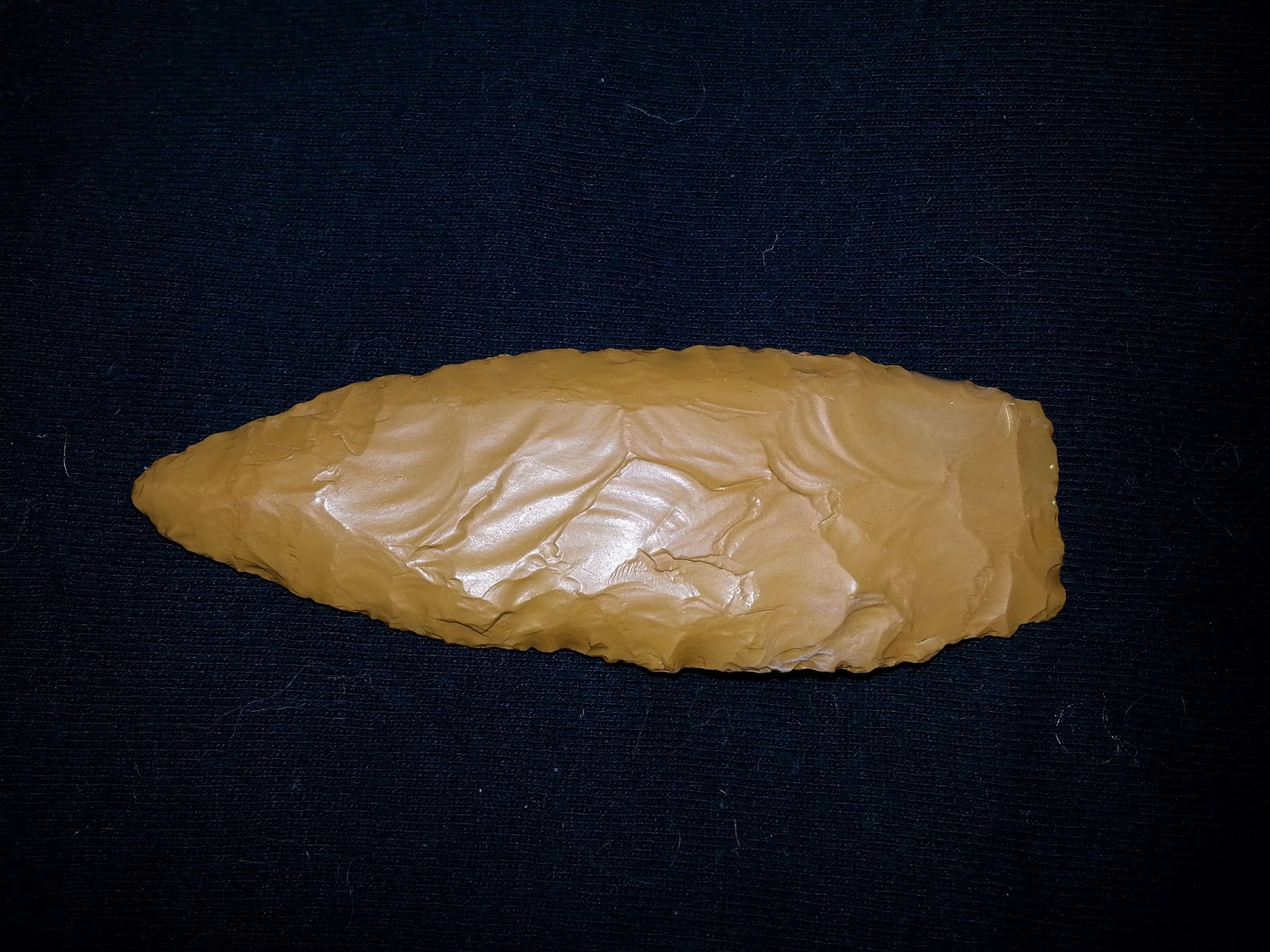
In 2007 I published a post (with photos) of an ancient jasper point that my neighbor, Edward Norvell, found on Ocracoke's beach. 


Although we were pretty sure the point was quite old, we are not trained anthropologists. Finally, after eight years, we have been able to contact a well-respected anthropologist whose specialty is the study of the Clovis Culture, a prehistoric, Paleo-Indian culture. We sent him photographs of the point, and this is what we discovered:

Although it is difficult to determine the provenance of an artifact only from photographs, the fact that the point has a flute on one side and a few flakes that go past the midline, plus a bevel on the opposite side from the flute, indicates that this is a Clovis "preform" (a not totally finished point, basically). In addition, it appears that some time later (there is no way to tell how much later) someone did further sharpening on the edges. In other words, someone began to make a Clovis point, got pretty far along, then abandoned the project. Then either she or someone else decided to sharpen it without finishing it up into a full Clovis point. The fact that it is not waterworn indicates it was buried under the sand offshore, then was dredged up and carried in during a storm. All of this suggests that  Clovis occupations were established near Ocracoke around 13,000 years before the present.

Earlier this year, I also published a blog post about a fossilized bison tooth that was found in the water near Springer's Point.


So, now we know that large mammals and Paleo-Indians were roaming these parts at the end of the last ice age, when sea levels were much lower and the coast of North Carolina was 70 to 80 miles farther seaward.

For more information, read Pat Garber's recent article in the Ocracoke Observer. Her article was written before we received the latest information about Edward Norvell's jasper point.

Our latest Ocracoke Newsletter is Part II of Crystal Canterbury's account of her first visit to Portsmouth Island. You can read it here: http://www.villagecraftsmen.com/news052115.htm. 

Friday, June 12, 2015

Williamsburg Public Gaol

Not long ago my son-in-law, Fiddler Dave, was in Colonial Williamsburg with the Molasses Creek band. He visited the Public Gaol, and sent me a droll email with this subject line: "Your ancestors lodged here!"

Photo by David Tweedie


According to information on the web identifying southeastern Virginia highway markers, "[t]he Williamsburg Gaol was erected in 1701. It was a brick prison with the dimensions of thirty by twenty feet with two stories, and was used for both prisoners and the jailer with his family. In addition to the interior rooms, there was also a courtyard, which was enclosed by walls so as to prevent escape during the prisoners’ recreation time. It was known 'as a strong, sweet Prison' and would be used into the period of the Civil War and beyond then .... Another set of reputable prisoners, were the associates of the infamous pirate Blackbeard. They were all executed in 1718. This was Virginia's chief prison which housed debtors and criminals and served as the jail for the General Court in the nearby Captiol. Here Blackbeard's pirates, captured in 1718, were confined until the day of their hanging. Leg irons, an exercise yard, food slots, and criminal cells with primitive sanitation have been restored to their early appearance.

According the official history of Colonial Williamsburg, "Virginia's general assembly ordered a 'substanciall brick prison' built in Williamsburg soon after it decided to make the city the colony's new capital. Known as the Public Gaol, the building's construction was authorized by an act of August 1701.... The Public Gaol's most celebrated occupants were 15 henchmen of the pirate Blackbeard, caught in 1718.... [T]he air [was described as] truly Mephytic.... [T]he Public Gaol was a place of discomfort and pestilence. Gaol fever – probably typhus – broke out from time to time, and the unheated cells often were overcrowded.... Manacles and chains were familiar parts of gaol life.... Strong timbers were laid beneath the cells to prevent 'under mining.'"

William Howard, quartermaster to Blackbeard the Pirate, and probable early owner of Ocracoke Island, was confined to the Public Gaol in 1718, and remained there into the fall, so he was not among Blackbeard's crew when his captain was captured and killed on November 22 by sailors of the Royal Navy under the command of Lt. Robert Maynard.

Howard was tried and sentenced to be hanged, but King George's pardon (The Act of Grace) was delivered to Williamsburg the day before his scheduled execution, so the quartermaster was released. My ancestor may have lodged at the gaol, but he died three quarters of a century later on Ocracoke Island.

Our latest Ocracoke Newsletter is Part II of Crystal Canterbury's account of her first visit to Portsmouth Island. You can read it here: http://www.villagecraftsmen.com/news052115.htm.

Thursday, June 11, 2015

Howard Street Hauntings

News Flash!!

My new book, Howard Street Hauntings, has just been published.


This is a sequel to my first book, Digging up Uncle Evans, which was based on our popular "Down Point" Ghost & History Walking Tour. The current volume, Howard Street Hauntings, is based on our "Around Creek" Ghost & History Walking Tour.

Howard Street Hauntings includes the stories of Old Diver (the unfortunate sailor whose ghost prowls graveyards on British Cemetery Road), Mad Mag (a long-dead housewife whose peculiar ways continue to frighten islanders), and Frank Treat Fulcher (a salty old sailor who became a Methodist preacher). You can also read about the woman who kept her casket in her parlor for seven years, the ghost ship of the Outer Banks, the suspended casket, and the phantom freighter, as well as tales from WWII, a recipe for Ocracoke Island meal wine, dramatic accounts of rescues by the United States Life-Saving Service, and more.

Howard Street Hauntings is available at Village Craftsmen, other Ocracoke Island stores, and on line at http://www.villagecraftsmen.com/islandbooks.htm#Hauntings. Also, on that same page, you can order Digging up Uncle Evans, or the two-book set.

Our latest Ocracoke Newsletter is Part II of Crystal Canterbury's account of her first visit to Portsmouth Island. You can read it here: http://www.villagecraftsmen.com/news052115.htm.

Wednesday, June 10, 2015

Change

On March 25 of this year I published a blog about pilot and photographer, Garrett Fisher and his spectacular aerial photos of the Outer Banks.

Garrett has just published a book of his photos, Sea of Change, Flying the Outer Banks. The book is available for purchase on line, and he hopes to have them in stores on Ocracoke this summer.


In his book, Fisher observes that "the essence of the Outer Banks is change.... Sand, surf, and sky are in a constantly rhythmic state of change.... Every single time I flew, the sand, ocean, currents, inlets, and sky looked different, [and] it was a matter of wholesale surprises each time...."

Sea of Change shows the Outer Banks as "more beautiful than most of us realize" and introduces us to aspects of these islands "that people do not know..., showing these unknown and poorly accessed areas in ways that are difficult if not impossible to see on the ground."

Garrett Fisher's book is a beautiful contribution to our understanding and appreciation of this fragile string of islands some of us call home.

Our latest Ocracoke Newsletter is Part II of Crystal Canterbury's account of her first visit to Portsmouth Island. You can read it here: http://www.villagecraftsmen.com/news052115.htm. 


Tuesday, June 09, 2015

Handwriting

On May 28 I wrote a blog post that included Kevin Duffus' photograph of a letter written in 1719.

Photo by Kevin Duffus


A reader commented on the lovely handwriting. And that reminded me of my great-grandfather's nineteenth century shipwreck reports. James Howard's penmanship is not as beautiful as Ellis Brand's, and his spelling and grammar are unconventional by today's standards (spide, redeness, flud, etc.), but his handwriting was superior to most of ours today.   

Capt. James W. Howard's Report


What a difference a few generations make! I seldom write letters, and my handwriting is a blend of printing and cursive. School children today are not even taught penmanship or cursive writing. All the more reason to treasure these letters and reports from the past.

Our latest Ocracoke Newsletter is Part II of Crystal Canterbury's account of her first visit to Portsmouth Island. You can read it here: http://www.villagecraftsmen.com/news052115.htm.

Monday, June 08, 2015

Recitals

Not long ago I was sitting on the pizer with Cousin Blanche. I can't remember what we were chatting about, but something reminded Blanche of a song from her youth (Blanche is 95 year old). She began to recite the lyrics of  "A Good Man is Hard to Find." (I did some research afterwards and discovered this song was composed and performed by Eddie Green during the time of piano rolls (1918). The song became a classic Blues standard, and was performed by Bessie Smith, Sophie Tucker, Frank Sinatra, and Brenda Lee. Flannery O'Connor wrote a short story with the same title in 1955.

Blanche recited the song flawlessly:

A good man is hard to find,
You always get the other kind
Just when you think that he's your pal,
You look for him and find him fooling around with some other gal
Then you rave, you even pray,
To see him lying in his grave.
So if your man is nice,
You better take my advice:
Hug him in the morning,
Kiss him every night,
Give him plenty of loving,
Treat him right
'Cause a good man nowadays is hard to find

When Blanche was finished with "A Good Man is Hard to Find" she was reminded of another song from her era, a hymn titled "A Perfect Day" written in 1909 by Carrie Jacobs-Bond (1862-1946). She recited that song for me also:

When you come to the end of a perfect day,
And you sit alone with your thought,
While the chimes ring out with a carol gay,
For the joy that the day has brought,
Do you think what the end of a perfect day
Can mean to a tired heart,
When the sun goes down with a flaming ray,
And the dear hearts have to part?
Well, this is the end of a perfect day,
Near the end of a journey, too,
But it leaves a thought that is big and strong,
With a wish that is kind and true.
For mem'ry has painted this perfect day
With colors that never fade,
And we find at the end of a perfect day,
The soul of a friend we've made.

But Blanche was just getting started. Next she began singing (not just reciting) "The Sidewalks of New York."

That reminded her of "A Bicycle Built for Two." I listened reverently as sweet melodies wafted down the sandy lane.

The song was over much too soon, but, alas, it was time for me to depart. Reluctantly, I arose, thanked her for the impromptu performance, and assured her I'd be back again before long.

Our latest Ocracoke Newsletter is Part II of Crystal Canterbury's account of her first visit to Portsmouth Island. You can read it here: http://www.villagecraftsmen.com/news052115.htm.

Friday, June 05, 2015

Festival Kickoff

Tonight, from 4 - 5 pm participants in Donald Davis' Storytelling Workshop will be sharing stories at Deepwater Theater.

From 5 - 7, at the Ocracoke Preservation Society Museum property, the Pony Island Restaurant will be providing fresh, locally caught fried fish and grilled chicken dinners for $15 a plate.

Between 6 & 7pm, at Berkley Manor, you can listen to Mahalo Jazz 2 (Alison Weiner on piano, vocals, and melodica) and Robbie Link (upright bass), two eclectic musicians coming together to have their delightful way with jazz standards and original tunes.


While there, you can also place silent bids on a wonderful assortment of fine art pieces donated by islanders and festival participants. 

Be sure to stick around for the live auction which starts at 7 o'clock. Afterwards head over to the Live Oak Stage (at Books to be Red) for a World Music Jam at 9 o'clock...then to the Community Center for the Donald Thompson Blues Band (and cash bar) at 10 pm.

Of course, the rest of the weekend is filled with more music, arts & crafts, dance, and other creative events. I will be taking it all in, and will be back Monday morning!

Our latest Ocracoke Newsletter is Part II of Crystal Canterbury's account of her first visit to Portsmouth Island. You can read it here: http://www.villagecraftsmen.com/news052115.htm.

Thursday, June 04, 2015

Dance

Every year at the Ocracoke Festival I lead a traditional island square dance.


The Ocracoke square dance was held regularly on the island from the mid 1700s until the early 1960s. In recent years the dance has been a feature of the Ocracoke Festival, the island's July 4th celebration, several fall get-togethers, and various other events. In the eighteenth and nineteenth centuries the dances were often held in private homes. Later they were held in public spaces including the lodge of the old Doxsee Clam Factory, on the dock at Captain Bill Gaskill’s Pamlico Inn, at Stanley Wahab’s Silver Lake Inn (now the Island Inn), and in the building that now houses the Ocracoke Variety Store.

The Ocracoke Island dance is actually a big circle dance, much like big circle dances performed in the Appalachian Mountains of the eastern United States. However, islanders traditionally referred to their dance as a square dance.

It is great fun...and easy to learn. Come out to the Community Square at 8 pm on Saturday for good music, energetic dancing, and good fun!

Our latest Ocracoke Newsletter is Part II of Crystal Canterbury's account of her first visit to Portsmouth Island. You can read it here: http://www.villagecraftsmen.com/news052115.htm. 

Wednesday, June 03, 2015

Festival 2015

The 2015 Ocracoke Music & Storytelling Festival begins this Friday, late afternoon, with stories, fish fry, art auction, jazz, blues, and a world music jam.

Click to Enlarge


The festivities continue all day on Saturday & Sunday morning, and include almost non-stop music plus clogging, juggling, a puppet parade, flea circus, additional stories...and more!

Click to Enlarge


Saturday evening features an open house on the skipjack Wilma Lee, and a traditional Ocracoke Island square dance, along with more music and storytelling.

The Ocracoke Festival showcases an outstanding collection of talent from the island, North Carolina, and elsewhere. What a great weekend! Hope to see you.

Our latest Ocracoke Newsletter is Part II of Crystal Canterbury's account of her first visit to Portsmouth Island. You can read it here: http://www.villagecraftsmen.com/news052115.htm.

Tuesday, June 02, 2015

Recent Arrivals

First there were mice and rats...brought to the island centuries ago as stowaways on sailing ships. I don't know how nutria got here, but I see them every once in a while. Then, sometime within the last 40 years, someone released a pair of minks. Next it was squirrels. What were these people thinking?

Deer are another recent arrival. They probably swam over here from Hatteras. I have seen two, just north of the NPS campground, and tracks are fairly common "down below" (anywhere north of the village).

Five years ago Gene Ballance sent me this photo of a raccoon foraging on his back porch. It was the first I had heard of raccoons on Ocracoke.


Just last week Frankie Garrish told me he startled two raccoons who were feeding in the cat dishes in Cousin Blanche's yard.

There have been raccoons on Portsmouth Island for many years. I suppose a couple of them were washed over to Ocracoke during a storm. It is probably impossible, now, to get rid of them.

Our latest Ocracoke Newsletter is Part II of Crystal Canterbury's account of her first visit to Portsmouth Island. You can read it here: http://www.villagecraftsmen.com/news052115.htm.

Monday, June 01, 2015

Detached Kitchens

When I was a child my grandparents' house (the house I live in today) had a detached kitchen. By the time I was born a kitchen (with a newfangled kerosene cook stove) had been installed inside the house. The old kitchen was converted to a spare bedroom. Eventually, termites and water damage did so much damage that the kitchen was torn down.

To my knowledge, the only original detached kitchen still on the island is at Cousin Blanche's house. Actually, the porch has been extended to connect the two structures, and the old kitchen is now a storage area, but it still looks basically the way it did many years ago. Here are three photos I took earlier this month:


Blanche told me she remembers when some islanders constructed outdoor temporary summer kitchens from saplings and tree branches. They would be used for just one season, then dismantled. But they served to keep the intense heat from the wood cook stove out of the main house.

Our latest Ocracoke Newsletter is Part II of Crystal Canterbury's account of her first visit to Portsmouth Island. You can read it here: http://www.villagecraftsmen.com/news052115.htm.

Friday, May 29, 2015

Betimes

This is another old-time word that you can still occasionally hear around Ocracoke village.. betimes. It means "early."

Betimes seems to have become common in the 13th century in England, but it is seldom heard today.

Several days ago a reader mentioned the Thrush Green novels by Miss Read (Dora Saint). I have not yet read any of them, but I understand they are set in a small village in southern England, and I am told the author uses the word "betimes."

Also, you will find the word in 2 Chronicles 36:15, in the  King James Version of the Bible: "And the Lord God of their fathers sent to them by his messengers, rising up betimes, and sending; because he had compassion on his people, and on his dwelling place."

Rise up betimes, and take a stroll along the beach. You will probably experience a beautiful sunrise, and you might even find a scotch bonnet.

Our latest Ocracoke Newsletter is Part II of Crystal Canterbury's account of her first visit to Portsmouth Island. You can read it here: http://www.villagecraftsmen.com/news052115.htm.

Thursday, May 28, 2015

One of the Most Mischievous and Vilest Villains

On 14 July, 1719, Capt. Ellis Brand of HMS Lyme penned a letter to the Lords of Admiralty. In it he referenced William Howard, quartermaster to Blackbeard the Pirate who many believe was the same William Howard who later became colonial owner of Ocracoke Island, as "one of the most mischievous, vilest villains that had infested that coast.” Author Kevin Duffus (Looking Glass Productions) photographed these two pages of the letter at the British Archives at Kew, and graciously offered to allow me to post them here.


Here is my best transcription of the relevant passage:

I having on board my Ship a pyrate that I had some time before taking up which knew this fellow when he was Quartermaster in Tachs Ship of forty guns call’d the Queen Anns Revenge, and he being allow’d to be a good Evidence I did desire of the Governor that this Quartermaster might be brought to Tryal, which he concented to and there being publick Notice of it several appeared against him, and it was made appear to the Court that he was One of the Most Mischevious and Vileist Villians that had infested that coast; he was found guilty and receiv’d sentence of Death Accordingly and his life is only owing to the Ships Arrival that had his Majesties pardon on board, the night before he was to have been exicuted; ....

Ellis Brand 

In the interest of  providing some balance to the legacy of my probable ancestor, Kevin added this comment in his email to me: "I’m sure that William Howard was not so vile. Mischievous maybe, but not vile. At some point I hope to remember where I read that Howard had traveled to the Bahamas to testify on behalf of a physician forced into piracy by Blackbeard."

Our latest Ocracoke Newsletter is Part II of Crystal Canterbury's account of her first visit to Portsmouth Island. You can read it here: http://www.villagecraftsmen.com/news052115.htm.

Wednesday, May 27, 2015

The Curlicue

As nearly everyone knows, Wilbur and Orville Wright, bicycle enthusiasts and remarkable innovators, accomplished the first controlled, powered, sustained heavier-than-air flight, on December 17, 1903, in Kitty Hawk, North Carolina.

The Wright brothers hailed from Dayton, Ohio, but traveled to the Outer Banks because the wind and terrain were more suitable for their flight experiments. You might think that soaring above the ground (even at just 10 feet of altitude) was a dangerous undertaking, but simply getting to Kitty Hawk in the first years of the 20th century was quite risky, as Wilbur's September, 1900, journal illustrates. A few excerpts:

"At 4:30 left for Eliz. City and put up at the Arlington where I spent several days waiting for a boat to Kitty Hawk. No one seemed to know anything about the place or how to get there. At last on Tuesday afternoon I engaged passage with Israel Perry on his fiat-bottom schooner fishing boat [the Curlicue]."

"The [skiff that took Wilbur to the fishing boat] leaked very badly and frequently dipped water, but by constant bailing we managed to reach the schooner in safety. The weather was very fine with a light west wind blowing. When I mounted the deck of the larger boat I discovered at a glance that it was in worse condition if possible than the skiff. The sails were rotten, the ropes badly worn and the rudderpost half rotted off, and the cabin so dirty and vermin-infested that I kept out of it from first to last."

"The boat was quite unfitted for sailing against a head wind owing to the large size of the cabin, the lack of load, and its flat bottom. The waves which were now running quite high struck the boat from below with a heavy shock and threw it back about as fast as it went forward. The leeway was greater than the headway. The strain of rolling and pitching sprung a leak and this, together with what water came over the bow at times, made it necessary to bail frequently."

"In a severe gust the foresail was blown loose from the boom and fluttered to leeward with a terrible roar. The boy and I finally succeeded in taking it in though it was rather dangerous work in the dark with the boat rolling so badly."

"[There was] another roaring of the canvas as the mainsail also tore loose from the boom, and shook fiercely in the gale. The only chance was to make a straight run over the bar under nothing but a jib, so we took in the mainsail and let the boat swing round stern to the wind. This was a very dangerous maneuver in such a sea but was in some way accomplished without capsizing."

You can read the entire journal entry here:  http://www.wright-brothers.org/History_Wing/Wright_Story/Inventing_the_Airplane/Off_on_Adventure/Off_on_Adventure.htm.

Our latest Ocracoke Newsletter is Part II of Crystal Canterbury's account of her first visit to Portsmouth Island. You can read it here: http://www.villagecraftsmen.com/news052115.htm.

Tuesday, May 26, 2015

Exchange Students

Over the last 25 years Ocracoke School has had a number of foreign exchange students. They came to us from Japan, Germany, Denmark, Argentina, Thailand, and Columbia. Ocracoke Island students have studied in the Netherlands, Germany, France, Japan, Australia, Denmark, Romania, Austria, and Ghana.

Pictured below (from l. to r.), with former Ocracoke School teacher Karen Lovejoy (herself a high school exchange student to Germany) are four of our foreign exchange students: Amy Howard (Germany), Emma Lovejoy (Denmark & Ghana), Molly Lovejoy (Austria), and Caroline Temple (Romania).


When Emma was living and studying in Ghana she met Esuon.They fell in love, he recently moved to the US, and they are now planning a fall wedding. Last week the Karen Lovejoy/Dave Frum family welcomed Esuon to Ocracoke with an outdoor potluck dinner at their home.

Potluck at the Lovejoy/Frum Home


L. to R.: Karen, Dave, Esuon, Emma, & Molly


Emma & Esuon


Our latest Ocracoke Newsletter is Part II of Crystal Canterbury's account of her first visit to Portsmouth Island. You can read it here: http://www.villagecraftsmen.com/news052115.htm.

Monday, May 25, 2015

Ocracoke Art

It is always fun to see plein air painters on Ocracoke. The other day I noticed a young artist on the corner of NC12 & British Cemetery Road (near the Harborside Motel). He was busily working on a painting of the two hexagonal buildings where Island Golf Carts and WOVV are located.


I stopped to chat for a few minutes. The artist was Mark Hunter Brown, a native North Carolinian who now lives in Chicago. In addition to showing his work in Chicago, Mark has also exhibited in Missouri, Ohio, Oregon, and Italy.

Here is a painting he made a couple of days ago, of the Wilma Lee.


You can see more of Mark's paintings, and read more about him, on his web site: http://markhunterbrown.com/home.html.

I also understand that Mark will be spending most of the summer on the island...and he will be playing William Howard in this year's production of A Tale of Blackbeard! 

Our latest Ocracoke Newsletter is Part II of Crystal Canterbury's account of her first visit to Portsmouth Island. You can read it here: http://www.villagecraftsmen.com/news052115.htm.

Friday, May 22, 2015

Firemen's Ball

The tenth annual Ocracoke Firemen’s Ball will be held tomorrow, Saturday, May 23, at the Ocracoke Community Center.


The event (the major fund raiser for the fire department) begins at 5 p.m. with a pig pickin’ followed by a silent and a live auction. The evening ends with live music by The Ocracoke Rockers, The Aaron Caswell Band, and The Dune Dogs.

Bidding for Great Items & to Support OVFD


This is the schedule of events:

5:00 – 6:30 Barbeque dinners @ $12.00 each
5:00 – 6:30 Silent auction (also, Firemen’s Ball t-shirts for sale)
7:00 Live Auction
8:30 -Midnight Music and Dancing

More information here and here. 

Our latest Ocracoke Newsletter is Part II of Crystal Canterbury's account of her first visit to Portsmouth Island. You can read it here: http://www.villagecraftsmen.com/news052115.htm.

Thursday, May 21, 2015

May Newsletter

We have just published our latest Ocracoke Newsletter, Part II of Crystal Canterbury's account of her first visit to Portsmouth Island. You can read it here: http://www.villagecraftsmen.com/news052115.htm. If you haven't read Part I, no worry. There is a link to Part I at the beginning of the article.

Enjoy!

Wednesday, May 20, 2015

Friends of Portsmouth Island

The Friends of Portsmouth Island held their spring membership meeting Saturday, May 16, at the Ocracoke Community Center. Several dozen people attended. Many were able to trace their ancestry to historic Portsmouth Island families.

The meeting commenced after a delicious and nutritious brunch provided by various members. After the secretary's and treasurer's reports, James White presented a plaque to Ken Burke in recognition of his contributions to the history of Portsmouth.

James White & Kenneth Burke


Ken Burke discovered Portsmouth in the 1950s, and immediately fell in love with the island, the village, and the people. In 1958 Ken wrote about Portsmouth as his honors thesis for a degree in history from the University of Richmond. It is titled The History of Portsmouth, North Carolina From Its Founding in 1753 to Its Evacuation in the Face of Federal Forces in 1861.

As James White explained, this was the first, and continues to be one of the most important documents chronicling the history of this unique island community. Ken Burke's text can be accessed on the web at  http://scholarship.richmond.edu/cgi/viewcontent.cgi?article=1410&context=honors-theses.

After the presentation, Glenn and Brenda White shared stories and photos documenting their time as National Park Service volunteers in Portsmouth Village.

The next Portsmouth Island Homecoming is scheduled for April 30, 2016. 

Our latest Ocracoke Newsletter is an article by island resident, Crystal Canterbury, about her very first visit to Portsmouth Village, on the last day of 2014. You can read Part I here: http://www.villagecraftsmen.com/news042115.htm.

Tuesday, May 19, 2015

The Paraguay

The 242' freighter, S. S. Paraguay, was built in 1900 to carry ore on the Great Lakes. Shortly thereafter, the Paraguay was converted to an oil tanker, plying the sea lanes in the North Atlantic Ocean. 

S.S. Paraguay, Courtesy M.W. Kates.(http://www.fleetsheet.com)


On December 4, 1927, the Paraguay (recently renamed the Kysikos) encountered a punishing gale off shore of the Outer Banks. While working the pumps in an effort to keep the embattled ship afloat, several crewmen were washed overboard by a huge wave. Early in the morning of the next day the Paraguay was driven ashore just north of Kitty Hawk. In spite of the weather, rescuers from the Kitty Hawk Life Saving Station managed to launch a life boat, and succeeded in rescuing the remaining 24 crew members.

While rehabilitating my house I discovered the following account of the Paraguay in a 1927 newspaper clipping laid down under the linoleum:

"Beachcomber Pays $100 for Wrecked ship And Expects to Realize $65,000 From It

"Underwriters of a Greek tank ship named Paraguay, which went ashore off Kitty hawk, N. C., during a storm on Dec. 4, have sold for $100 a property which is expected to yield the present owner more than $65,000.

"One of the beachcombers, who makes a practice of buying wrecks for such stores aboard as may be salvaged, paid $100 for the Paraguay. He took off wireless apparatus and stores worth $4,500 and sold the rest of the hulk to dealers in Norfolk, Va., for $1,500 or more.

"The wreck is laden with 800,000 gallons of fuel oil, and the beachcomber expects to sell this for $60,000. The former owners of the Paraguay lose nothing, since they were insured.

"Two men were lost off the Paraguay when she struck the beach. The tanker broke in half almost as soon as she hit, but the cargo section is intact and the oil still aboard. The salvager expects to have no trouble beaching the cargo."

According to Minor Kates, Jr. on his web site (http://www.fleetsheet.com/paraguay.htm), "the Kyzikos [the Paraguay] rests just offshore of Kill Devil Hills at Mile Marker 7. This site is very popular with scuba divers."

Our latest Ocracoke Newsletter is an article by island resident, Crystal Canterbury, about her very first visit to Portsmouth Village, on the last day of 2014. You can read Part I here: http://www.villagecraftsmen.com/news042115.htm.

Monday, May 18, 2015

Salt

Amy loaned me her copy of Mark Kurlansky's 2002 book, Salt. It was fascinating to learn how important and valuable salt has been in the history of the world. And that got me to wondering...were there ever attempts to harvest or produce salt in eastern North Carolina? This is what I discovered in David Stick's book, The Outer Banks of North Carolina:
  • In September, 1775, the Provincial Congress offered a bounty of 750 pounds "to any person who shall erect and build proper works for Manufacturing common Salt on the sea shore."
  • Two ventures were begun in the Beaufort, NC, area, one designed to flood coastal areas and produce salt by solar evaporation, the other producing salt by boiling salt water in large vats.
  • Heavy rains thwarted one operation; the drowning of the operator terminated the other venture.
  • The wreck of the Success (sailing from Bermuda to North Carolina) in January, 1788, and loss of her cargo of salt, was of great concern because there had been an acute shortage of salt in North Carolina since the outbreak of the Revolutionary War.
  • In September, 1776, delegates from the North Carolina Council of Safety wrote to the delegates to the Congress in Philadelphia that, "It is impossible for us to describe the distressed Situation of this State for the want of Salt. The Inhabitants in general say only let them have that article and they will fight so long as they have Existence, in support of the just rights of their Country. Without it, themselves, Families and stocks must perish."
  • Benjamin Franklin then made available pamphlets on "making Salt by Sun Evaporation or by Culinary fire."
  • After this information was distributed on the Outer Banks, it was reported that "The Humour of Salt boiling seems to be taking place here....Every Old Wife is now scouring her pint pot for the necessary operation."
Salt was an important product that was used to cure fish and ham. Without it, eighteenth century Outer Banks sustenance and commerce was in serious jeopardy. Luckily, abundant salt water and Ben Franklin's pamphlet saved the day!

Our latest Ocracoke Newsletter is an article by island resident, Crystal Canterbury, about her very first visit to Portsmouth Village, on the last day of 2014. You can read Part I here: http://www.villagecraftsmen.com/news042115.htm. 


Friday, May 15, 2015

What's With These Road Names?

While driving around Ocracoke Village you may have noticed the intersection of Ocean View Road and Old Beach Road.


These two roads are surrounded by houses, cedars,and other thick vegetation. There is certainly no view of the ocean...nor are they on, or even near, the beach. You may wonder, What gives?

The answer to the question lies in the history and geology of Ocracoke Island. Before NC Highway 12 was built in 1957, the area between the village and the National Park Service campground was three miles of barren tidal flats...sand, shells, and hardly a blade of sea grass. During high tides, ocean overwash inundated the flats.

In the 1950s and 1960s, the National Park Service and the State of North Carolina decided to protect the new highway by building a continuous row of artificial dunes between NC12 and the Atlantic Ocean. Over the years vegetation took root on the dunes and the sound-side flats (islanders have always called that area The Plains). First it was just grasses. Then came yaupons and myrtles, and later cedars. Today, even pines and a few oaks are starting to grow there.

Where once the beach extended as far as the Thurston House B&B (my dad said islanders thought Thurston Gaskill was crazy to build his house "on the edge of the beach"), then retreated to where the Variety Store is located, the "bald beach" is now contained by the ocean-side dune ridge.

So, 75 years ago you could see the ocean from Ocean View Road, and Old Beach Road was a sand track that would take you right across the Plains to the surf.

And now you know.

Our latest Ocracoke Newsletter is an article by island resident, Crystal Canterbury, about her very first visit to Portsmouth Village, on the last day of 2014. You can read Part I here: http://www.villagecraftsmen.com/news042115.htm.

Thursday, May 14, 2015

Senators & Pirates

As regular readers of this blog probably already know, I enjoy words and their origins...and I especially enjoy obscure words that relate to Ocracoke, or in today's case, pirates. I recently learned that the English word, freebooter (one who pillages and plunders, especially a pirate), derives from the Dutch words vrij (meaning free) + buiter (meaning booty). The French have a cognate,  fribustier or flibustier; and the Spanish have filibustero.   

In the mid-19th century a "filibuster" came to mean a meddler or troublemaker, especially a US citizen who interfered in the affairs of Central American nations. For example, William Walker (1824-1860) has been described as an "adventurer, filibuster, and revolutionary leader who succeeded in making himself president of Nicaragua (1856–57)."*

Of course, a filibuster also came to mean a long, windy senatorial speech intended to thwart passage of specific legislation. Regardless of your political persuasion (and I write this not to provoke partisan politics, but as interesting trivia related to Ocracoke and pirates!), you may be amused to discover that the word filibuster is related to pirates and senators.

You can read more about the word filibuster here: http://www.merriam-webster.com/blog/how-senators-are-like-pirates.htm.

Our latest Ocracoke Newsletter is an article by island resident, Crystal Canterbury, about her very first visit to Portsmouth Village, on the last day of 2014. You can read Part I here: http://www.villagecraftsmen.com/news042115.htm. 

* http://www.britannica.com/EBchecked/topic/634642/William-Walker

Wednesday, May 13, 2015

Distemper

Most of us, when we hear the word "distemper," think of an infectious disease that afflicts dogs. Canine distemper is caused by an unidentified virus that manifests in lethargy, fever, excessive discharge of mucus in the nose & throat, intolerance of light, and vomiting.

But, if you happen to pay a visit to the Ocracoke Health Clinic, you may hear an older island native in the waiting area comment that he or she is there to see the doctor for distemper. Knowing the local doctor is not a veterinarian, you finally figure out that the person sitting next to you is talking about his/her own illness.

"Distemper" is an eighteenth century word that simply meant any illness or disease. While the definition of the word has been narrowed today to refer almost exclusively to an illness afflicting dogs (and sometimes cats and horses), a few old-time Ocracokers still use the word in its older, more general sense.

Our latest Ocracoke Newsletter is an article by island resident, Crystal Canterbury, about her very first visit to Portsmouth Village, on the last day of 2014. You can read Part I here: http://www.villagecraftsmen.com/news042115.htm. 

Tuesday, May 12, 2015

"Shipwreck"

Just a couple of days ago I was told about a small boat that washed up on Ocracoke's beach. Of course I wanted to see for myself.


The fiberglass boat was quite a derelict. It certainly looked like it had been adrift for a while. The motor was long gone, the paint was peeling, the hull was cracked & broken, and small mollusks were growing all over the bottom. I suppose it was pushed onto Ocracoke's beach by the wind and waves generated by tropical depression Ana.

I wonder who will remove it.

Our latest Ocracoke Newsletter is an article by island resident, Crystal Canterbury, about her very first visit to Portsmouth Village, on the last day of 2014. You can read Part I here: http://www.villagecraftsmen.com/news042115.htm. 

Monday, May 11, 2015

British Cemetery

In the spring of 1942, the British Navy sent 24 armed trawlers to the east coast of the United States to augment the fleet of the US Navy in WWII.

On May 11, 1942, the captain of the German U-boat, U-558, fired three torpedoes at the British armed trawler, Bedfordshire. The third torpedo struck the vessel amidships with devastating results. The ship sank within minutes, killing everyone on board.

The bodies of four British sailors washed ashore at Ocracoke, and were laid to rest near the Capt. David Williams cemetery. Every year since then, the US Coast Guard, British & Canadian military officials, and local Outer Banks organizations honor the crew of the Bedfordshire and other sailors who lost their lives protecting the United States from Nazi aggression.

Samantha Styron Reading History of the Bedfordshire's Sinking


This year the commemorative event was held on Friday, May 8, at 11:00 am.

US Coast Guard Pipe Band


You can read more about the British Cemetery ceremonies in the Ocracoke Current and the Ocracoke Observer.

Our latest Ocracoke Newsletter is an article by island resident, Crystal Canterbury, about her very first visit to Portsmouth Village, on the last day of 2014. You can read Part I here: http://www.villagecraftsmen.com/news042115.htm.

Friday, May 08, 2015

Portsmouth Trivia

This month's Ocracoke Newsletter is about Crystal Canterbury's first visit to Portsmouth Village (see the link at the bottom of this post).

Photo by Crystal Canterbury


Here are a few tidbits of information about Portsmouth (from David Stick's book, The Outer Banks of North Carolina:
  • Portsmouth, unlike Ocracoke and other Outer Banks communities, was a planned town.
  • Portsmouth town was laid out in half-acre lots, with designated streets.
  • Town lots were sold for 20 shillings in the mid-1700s.
  • John Tolson purchased the first lot on February 12, 1756 (members of the Tolson family live on Ocracoke to this day).
  • Fort Granville was built on Portsmouth. It was garrisoned in 1758.
  • On a 1775 map showing the Outer Banks, only one road is depicted. It extended from Portsmouth to Core Banks.
  • Population of Portsmouth in 1800 was 246.
  • An academy was established on Portsmouth by 1806.
  • Population in 1810 was 387.
  • In 1836-1837 more than 1,400 vessels passed through Ocracoke Inlet.
  • In 1846 the federal government established a marine hospital on Portsmouth.
  • In 1866 The Excelsior Oil and Guano Company established a menhaden processing plant on Portsmouth.
  • Between 1876 & 1885 a US Weather Bureau Station was located on Portsmouth.
  • Portsmouth also had a US Life-Saving/Coast Guard Station from the late 1800s to WWII.
  • Population in 1850 was 505.
  • Population today is 0. 
 Our latest Ocracoke Newsletter is an article by island resident, Crystal Canterbury, about her very first visit to Portsmouth Village, on the last day of 2014. You can read Part I here: http://www.villagecraftsmen.com/news042115.htm.

Thursday, May 07, 2015

Island People, Inselmenschen

In 2000 the Trustees of Boston University published a coffee-table book of photographs by German photographer, Ulrich Mack. Titled Island People, Inselmenschen, Mack's book is a bi-lingual photographic study of the similarities between the people and culture of Harkers Island, North Carolina, and Pellworm, an island in the North Sea, in Nordfriesland District of Schleswig-Holstein, Germany.

I have not been able to contact Ulrick Mack to ask for permission to publish a couple of his photos, but I did find this YouTube video of Herr Mack discussing his book and the pictures.


Even though the audio is in German, you will be able to see the remarkable similarities between Harkers Island and Pellworm. They are striking.

The YouTube description under the video says "From November 17, 2007, in the Grassi Museum for Ethnology in Leipzig, Ulrich Mack will exhibit his study of the similarities between two north Atlantic island cultures: Pellworm (Nordfriesland) and Harkers Island (North Carolina)."

I believe the book is no longer in print, but it can be purchased on-line for about $25.00. One reviewer had this to say about the book: "Powerful imagery. Inspiring photography. A treasure of times past. The similarities of Island People from a German Island and a United States Island is unbelievable."

Our latest Ocracoke Newsletter is an article by island resident, Crystal Canterbury, about her very first visit to Portsmouth Village, on the last day of 2014. You can read Part I here: http://www.villagecraftsmen.com/news042115.htm.

Wednesday, May 06, 2015

Old Newspapers

In 2005, when I rehabilitated my grandparents' island house, I discovered a number of yellowed, brittle newspapers under the linoleum that had been laid down on the floors. I salvaged various articles and advertisements, most from 1928, 1945, & 1948. Just the other day I found them in a picture album.


Here is a sample of what I discovered:
  • A "stubborn cough" can be cured by drinking a mixture of sugar or honey and creosote (1928).
  • These ailments can all be cured with various treatments and ointments available for sale:
    • Varicose Veins (Relieved "At Once")
    • Whiskey or Drug Habit (Cured Forever)
    • Asthma (Stopped or No Pay!)
    • Vision problems (No Glasses Needed)
    • Bunions ("Gone in Days")
  • The "New Easy Spindrier" (No old-fashioned wringing) can be purchased for $189.95.
  • "Ambitious Girls" can make $23 for a 40-hour work week, as telephone operators.
  •  Railroad Engineers made average annual earnings of $3,965 in 1939.
  • A ten-year-old Plymouth convertible (new paint, rebuilt engine) could be had for $595 in 1949.
  • In 1928 Beatrice Fuller (a "white girl" who is "a descendant of the Mayflower pilgrims") married Clarence Kellem ("a mulatto") in Connecticut, in spite of threats and protests (including "a flaming cross on a high hill"). 
  • On May 8, 1948, Methodists adopted a "Resolution Aimed at End of Racial Segregation in Southern Churches."
  • A seven-year-old boy is "healthy and happy" in spite of having his heart in the right side of his chest.
  • Goldfish swim fastest in "Mildly Warm Water."
Remember, I am publishing these tidbits as a glimpse into history, and into the news available to islanders 65 to 85 years ago, not to provoke political rants. Please keep this in mind when posting comments.

Our latest Ocracoke Newsletter is an article by island resident, Crystal Canterbury, about her very first visit to Portsmouth Village, on the last day of 2014. You can read Part I here: http://www.villagecraftsmen.com/news042115.htm.

Tuesday, May 05, 2015

End of an Era

Many visitors to Village Craftsmen will remember the red gypsy wagon. For a while it was displayed next to the shop. In more recent years it was parked behind the Village Craftsmen, but visible from Howard Street. I built it about 35 years ago, and it was used for various artistic and creative endeavors, as well as temporary housing for family & friends.

The gypsy wagon sported a number of decorative features, including s Dutch door, brass lanterns, etched glass windows, and painted-yellow curlicues. The interior was compact, but comfortable, and was decorated with silk curtains and tassels.


Unfortunately, the ravages of time, water damage, and termites resulted in so much rotted wood and a completely rusted frame, that the gypsy wagon was no longer useable, so I decided to dismantle it. To save the gypsy wagon would have entailed more work than building it in the first place. And I decided it was better to have it removed than to watch it slowly disintegrate. As a friend once remarked, nothing lasts forever.


Nevertheless, many islanders and visitors will have fond memories of the gypsy wagon, a unique contribution to the sometimes unusual experience of life on Ocracoke Island.

Our latest Ocracoke Newsletter is an article by island resident, Crystal Canterbury, about her very first visit to Portsmouth Village, on the last day of 2014. You can read Part I here: http://www.villagecraftsmen.com/news042115.htm.

Monday, May 04, 2015

Passenger Ferries

According to the NCDOT Ferry Division, the Provincetown III, a catamaran-style passenger ferry will visit the Outer Banks today and tomorrow, May 4-5, The Ferry Division says it could be a glimpse into the future of a new type of ferry service between Hatteras and Ocracoke. During that visit, NCDOT Ferry Division officials will be offering members of the public a chance to tour the ship for themselves and provide valuable feedback as they study the idea of passenger service between the two villages.


The ship will conduct sea trials today and tomorrow, and will be available for inspection today on Hatteras. Tomorrow the ship will conduct further sea trials, then dock at Silver Lake Harbor in Ocracoke.

Members of the public will be allowed to tour the ship between 4-7 p.m., while the Ferry Division conducts an open house meeting between 5 and 7 p.m. at the Ocracoke School gymnasium.

"This is the public's ferry system, and establishment of passenger ferry service would be a significant change to that system," said Ferry Division Director Ed Goodwin. "We hope that people will turn out to take a look at the ship and give us any feedback they have on any aspect of this idea."

NCDOT has hired the consulting firm Volkert to conduct a feasibility study on passenger ferry service between Hatteras and Ocracoke Islands as an additional alternative (not a replacement) to the car ferries now running the route. The study is scheduled to be completed by December, 2015.

Our latest Ocracoke Newsletter is an article by island resident, Crystal Canterbury, about her very first visit to Portsmouth Village, on the last day of 2014. You can read Part I here: http://www.villagecraftsmen.com/news042115.htm.

Friday, May 01, 2015

Ocracoke Night Life

If you are planning a vacation to Ocracoke this season, you have several opportunities to enjoy island night life. Mark your calendars now. On Wednesday evenings at 8 pm, beginning in June, there is always the delightful Ocracoke Opry at Deepwater Theater featuring local musicians (including our high-energy Molasses Creek band and other performers) and storytellers.

Another opportunity this year is a National Park Service program on "the night sky and naturally glowing marine life."

Milky Way by Craig Roberts


This NPS program is scheduled for every Wednesday from 05/27/2015 to 09/02/2015, at Ocracoke's Lifeguard Beach from 8:30 PM to 9:30 PM.

Our latest Ocracoke Newsletter is an article by island resident, Crystal Canterbury, about her very first visit to Portsmouth Village, on the last day of 2014. You can read Part I here: http://www.villagecraftsmen.com/news042115.htm.